Unified Modeling Language (UML) is a standardized modeling language used for specifying, visualizing, constructing, and documenting the artifacts of software systems. It was created by the Object Management Group (OMG) and has become a vital tool in software engineering.
Unified Modeling Language (UML) is a standardized modeling language used for specifying, visualizing, constructing, and documenting the artifacts of software systems. Developed by the Object Management Group (OMG), UML was first proposed in January 1997 and has
Understanding the thirteen diagrams of UML 2.x is crucial for grasping Object-Oriented (OO) development, especially within the context of Agile Development. While modeling encompasses more than just UML, UML defines the standard artifacts for object technology. UML diagrams are categorized …
A UML (Unified Modeling Language) Component Diagram is a type of diagram that shows how components are wired together to form larger components or software systems. Components represent modular parts of a system that encapsulate their contents and whose …
Composite Structure Diagrams (CSDs) are a vital part of the Unified Modeling Language (UML), providing a detailed view of the internal structure of a class and the collaborations that this structure makes possible. This article will delve into the …
A Composite Structure Diagram (CSD) is a type of UML structural diagram introduced in UML 2.0. It provides a detailed view of the internal structure of a classifier, showing its parts, ports, and connectors. This guide will explain the …
In the realm of software design, visualizing the structure and interactions of a system is crucial. Two essential types of diagrams used for this purpose are Composite Structure Diagrams and Component Diagrams. Both are categorized under Structural Diagrams and serve …
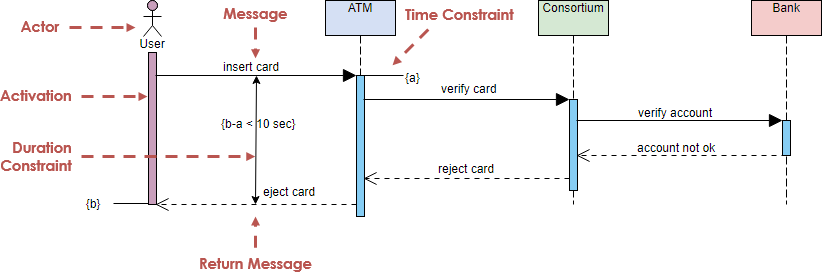
UML (Unified Modeling Language) sequence diagrams are a type of interaction diagram that details how operations are carried out—what messages are sent and when. They capture the interaction between objects in a sequential order. This guide will help beginners …
Unified Modeling Language (UML) sequence diagrams are a type of interaction diagram that details how operations are carried out in a system—what messages are sent and when. They capture the interaction between objects in a sequential order, making them …
In the realm of software engineering and object-oriented design, the Unified Modeling Language (UML) serves as a standardized way to visualize the design of a system. One of the fundamental building blocks in UML is the concept of a class.