Bridging the Gap Between Concept and Code
In the complex landscape of software development, the transition from a client’s vague requirements to a concrete technical architecture is often the most perilous phase. Business analysts and system architects frequently struggle to translate high-level goals into actionable specifications without getting bogged down in manual documentation. This disconnect can lead to scope creep, misunderstood requirements, and costly rework.
Visual Paradigm’s Use Case Modeling Studio offers a solution by integrating Generative AI into the requirements engineering process. This tool allows teams to transform simple concept descriptions into fully documented projects—complete with UML diagrams, test cases, and database schemas—in a fraction of the time usually required. This guide explores the workflow of creating a hypothetical dining application, “GourmetReserve,” to demonstrate how AI can streamline system design.
Defining Scope and Identifying Actors
Every successful software project begins with a clearly defined scope. The Use Case Modeling Studio provides a structured environment to establish the boundaries of a system immediately. Instead of manually listing every potential user, the workflow begins with a simple text input describing the system’s primary function.
For the “GourmetReserve” example, the input focuses on allowing diners to book tables and pre-order meals. The AI-assisted scope generator analyzes this input to derive:
- Scope Statement: A professional definition of the system’s boundaries and core benefits, such as optimizing kitchen workflows.

- Actor Identification: Intelligent algorithms suggest relevant stakeholders. For a dining app, this includes the “Diner,” “Restaurant Manager,” and external systems like “Payment Gateways.”

This automated identification ensures that no critical interaction point is overlooked during the initial planning phase, setting a solid foundation for the project.
Visualizing Requirements with Automated Diagrams
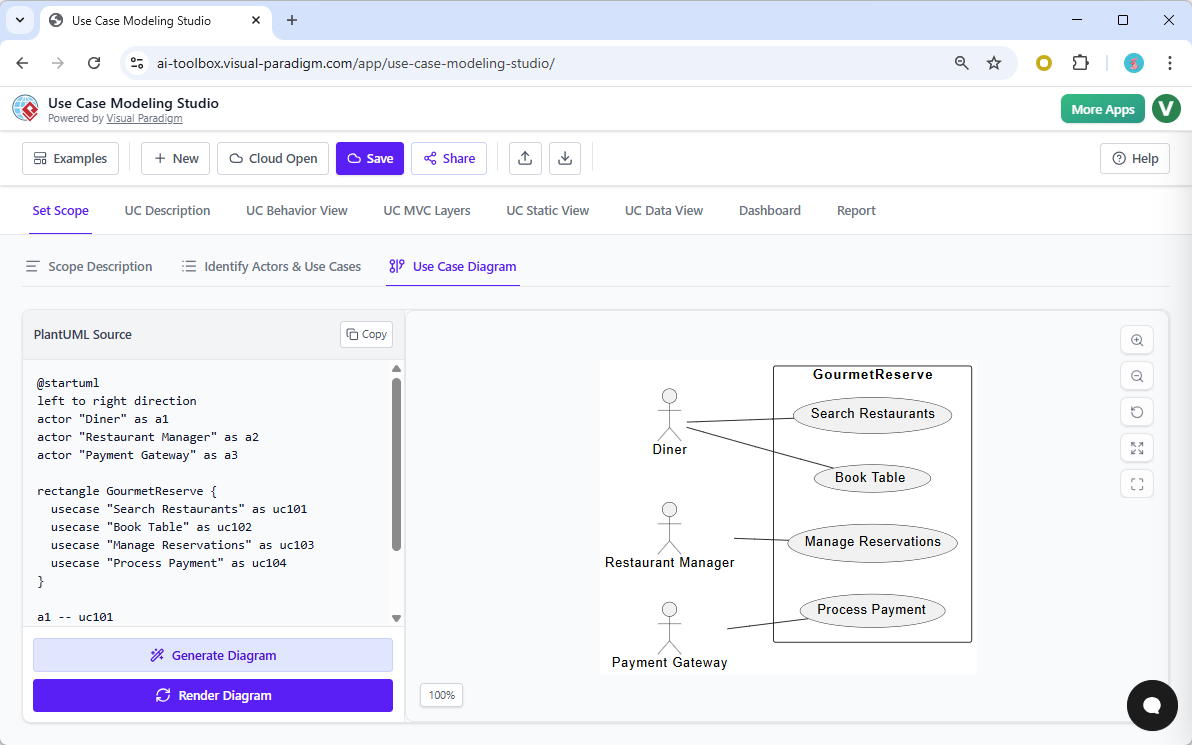
Visual communication is paramount in system analysis. Traditionally, creating a Use Case Diagram requires tedious drag-and-drop operations. Modern AI tools revolutionize this by generating the diagram automatically based on the textual data provided in the scoping phase.
The result is a clean, standard-compliant UML diagram that visually maps the relationships between the actors and their goals, such as “Search Restaurants,” “Book Table,” or “Manage Reservations.” This live-updating diagram serves as the “big picture” view, ensuring alignment between business goals and system capabilities.
Generating Detailed Specifications
While diagrams provide an overview, the detailed logic lives in the specifications. Writing these out manually is often where projects experience bottlenecks. The Use Case Modeling Studio accelerates this by using Generative AI to draft comprehensive use case descriptions.
By selecting a use case like “Search Restaurants,” the tool produces a structured narrative that includes:
- Brief Description: A summary of the functionality.
- Preconditions: Requirements such as user authentication.
- Flow of Events: A step-by-step breakdown of the user’s interaction with the system.
Modeling System Behavior and Interactions
With the requirements defined, the focus shifts to behavioral modeling. The platform allows users to instantly translate textual descriptions into visual workflows, ensuring consistency between documentation and diagrams.
Activity Diagrams
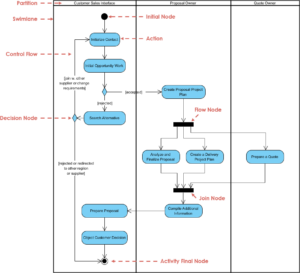
The tool can convert a use case narrative into an Activity Diagram. This flowchart visualizes logic paths, decision points (such as checking for internet connectivity), and the sequence of steps a user takes to complete a task. This automated conversion eliminates the common error of having diagrams that contradict the written specifications.

Sequence Diagrams
For a more technical view of the system’s execution, a UML Sequence Diagram can be generated. This artifact details the chronological exchange of messages between the actor and the system. In the “GourmetReserve” example, the diagram illustrates the interaction flow: the Diner opens the app, the system validates the login, and search parameters are processed. This level of detail helps developers identify potential logic gaps before code implementation begins.

Bridging Requirements to Technical Architecture (MVC)
One of the most advanced capabilities of the Use Case Modeling Studio is its ability to bridge the gap between functional requirements and technical architecture. The tool analyzes use case descriptions to suggest a Model-View-Controller (MVC) structure.
For the dining app, the AI identifies:
- Model Objects: Restaurant, User, CuisineType.
- View Components: SearchScreen, RestaurantList.
- Controller Logic: SearchController.

To further clarify these architectural components, users can generate an MVC Sequence Diagram. Unlike the business-level sequence diagram, this technical diagram visualizes internal object interactions, mapping out how the View communicates with the Controller and how the Controller queries the Model. This provides a direct blueprint for implementation adhering to standard software design patterns.
Data Modeling and Quality Assurance
Domain Modeling and Database Design
Moving from behavioral to structural modeling, the tool assists in defining the data domain. By analyzing the nouns and concepts within the use case description, the software generates a Class Diagram. This defines the attributes and relationships of the system’s objects.
Furthermore, this Class Diagram can be transformed into an Entity-Relationship Diagram (ERD) to prepare for database implementation. This visualizes the database schema, defining primary keys, foreign keys, and data types (e.g., varchar, int), providing a direct specification for database engineers.
AI-Generated Test Cases
Quality assurance is integrated directly into the design workflow. Based on the flows and preconditions defined in the use cases, the tool automatically generates a comprehensive set of test cases. Each entry includes a Test ID, specific scenarios (e.g., “Main Search with Valid Filters”), step-by-step instructions, and expected results. This significantly reduces the workload for QA teams and ensures test plans are perfectly aligned with requirements.
Conclusion
The journey from a high-level idea to a fully specified technical design is typically fraught with ambiguity and manual effort. Visual Paradigm’s Use Case Modeling Studio fundamentally changes this dynamic. By automating the creation of diagrams, specifications, test cases, and database models, it allows teams to focus on the logic and quality of their system rather than the mechanics of documentation. For professionals looking to elevate their requirements engineering and system design workflow, utilizing AI-powered design tools offers a compelling blend of efficiency and strict UML adherence.