
Unified Modeling Language (UML) serves as the standard visual language for specifying, constructing, and documenting the artifacts of software systems. While class diagrams form the backbone of object-oriented design, the true power lies in how these classes interact. The relationships between classes define the structural integrity and behavioral logic of the entire system. Understanding the nuances between Association, Aggregation, and Composition is critical for creating robust, maintainable, and scalable architectures.
Many developers struggle with the subtle distinctions between these three concepts. Confusing them can lead to tight coupling, memory leaks, or ambiguous lifecycle management. This guide explores each relationship type in depth, focusing on ownership, lifecycle dependency, and cardinality. We will examine the visual notations, the semantic meanings, and the practical implications of choosing one over the other.
1. Understanding Association: The Foundation of Connection 🔗
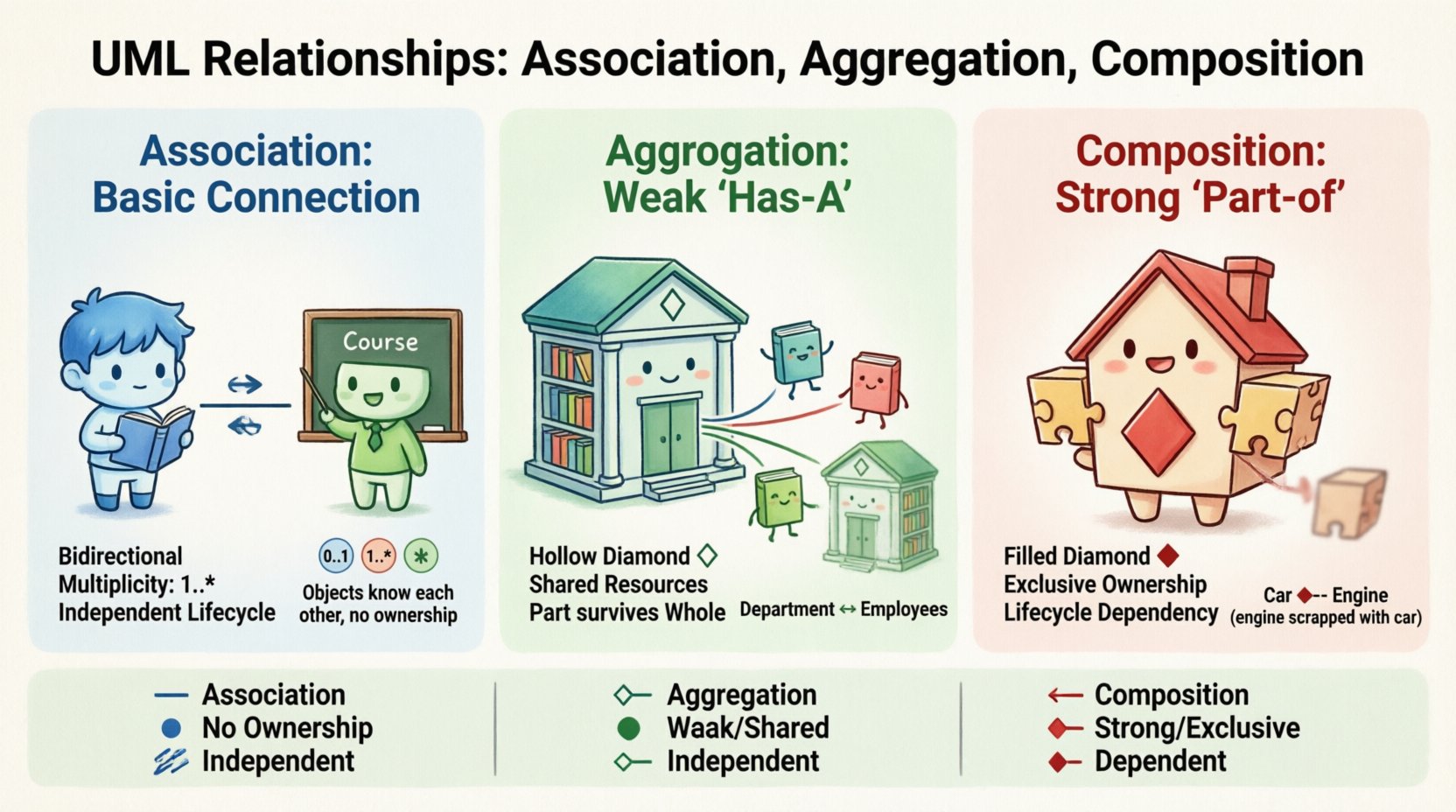
Association represents the most basic form of relationship between two classes. It describes a structural link where objects of one class are connected to objects of another class. In simple terms, it defines how classes know about each other.
Core Characteristics of Association
Directionality: Associations can be unidirectional or bidirectional. A unidirectional association means one class knows about the other, but not vice versa.
Navigation: This determines which object can access the attributes or methods of the associated object.
Multiplicity: Defined as numbers or ranges (e.g., 1, 0..1, *) indicating how many instances participate in the relationship.
Visually, an association is represented by a solid line connecting two class rectangles. If the relationship has a name, it is placed near the line. If there is a specific direction, an arrowhead indicates the navigability.
Real-World Scenarios
Consider a scenario involving a Student and a Course. A student enrolls in a course. This is a classic association.
One student can enroll in multiple courses.
One course can have multiple students.
Deleting a student does not necessarily delete the course.
Deleting a course does not necessarily delete the student record.
In this case, the association is bidirectional. Both classes maintain a reference to each other. This flexibility allows for complex queries, such as “Show all courses for a specific student” or “Show all students enrolled in a specific course”.
Multiplicity Notation
Associations are rarely simple one-to-one connections. The multiplicity defines the cardinality constraints:
1: Exactly one instance.
0..1: Zero or one instance (optional).
1..*: One or more instances.
0..*: Zero or more instances.
For the Student-Course example, the multiplicity might look like this:
Student to Course: 1 to 0..*
Course to Student: 1 to 0..*
This notation ensures data integrity within the model. It prevents scenarios where a student must be assigned to exactly 10 courses or where a course cannot exist without at least one student, unless the business rules explicitly dictate such constraints.
2. Aggregation: A Specialized “Has-A” Relationship 🚗
Aggregation is a specific type of association that represents a “Whole-Part” relationship. However, unlike other relationships, the lifecycle of the part is independent of the whole. This means the part can exist without the whole.
Key Distinctions of Aggregation
Weak Ownership: The whole class does not control the lifecycle of the part class.
Independence: The part can be shared among multiple wholes.
Visual Notation: Represented by a solid line with a hollow diamond (◊) at the “whole” end.
Think of a Library and its Books. The library contains books, but the books are not owned by the library in a way that destroys them when the library closes. The books might belong to authors or publishers. If the library is dismantled, the books still exist and can be placed in another library or sold.
Shared Resources
Aggregation is often used to model shared resources. Consider a Department and its Employees.
A department consists of employees.
If a department is dissolved, the employees do not cease to exist.
An employee might work across multiple departments (e.g., a consultant).
In this model, the Department aggregates the Employees. The hollow diamond sits on the Department side of the line, pointing towards the Employees. This visual cue tells the architect that the Department manages the collection, but does not own the lifecycle.
Implementation Considerations
When implementing aggregation in code, the relationship is typically handled via a reference or pointer. The “whole” class holds a list or collection of “part” class instances. However, the constructor of the “whole” does not create the “part” instances.
Creation: The part instances are created externally.
Assignment: The whole instance receives a reference to the part.
Destruction: The whole instance can remove the reference, but it does not call the destructor or delete the part instance.
This separation of concerns is vital for memory management. It prevents orphaned objects when the container is destroyed, provided the container does not explicitly manage the memory of the contained objects.
3. Composition: Strong Ownership and Lifecycle Dependency 💣
Composition is the strongest form of association. It is a “Whole-Part” relationship where the part cannot exist independently of the whole. The lifecycle of the part is strictly tied to the lifecycle of the whole.
Defining Characteristics of Composition
Strong Ownership: The whole is responsible for the creation and destruction of the part.
Exclusive Existence: A part belongs to only one whole at a time.
Visual Notation: Represented by a solid line with a filled diamond (◆) at the “whole” end.
Consider a House and its Rooms. A house is composed of rooms. If the house is demolished, the rooms cease to exist in that context. A room cannot exist without the house structure that defines its boundaries. You cannot take a room from one house and put it into another house intact.
Lifecycle Management
In composition, the whole object is the creator of the part object. When the whole object is instantiated, the part object is instantiated. When the whole object is destroyed, the part object is destroyed.
Creation: The whole creates the part in its constructor.
Destruction: The whole deletes the part in its destructor.
Sharing: Parts are generally not shared. A specific engine instance belongs to one car instance.
Visual Representation
The filled diamond is the key differentiator from aggregation. It signifies containment and dependency.
Car and Engine: A car is composed of an engine. If the car is scrapped, the engine is scrapped. The engine cannot function or exist independently of the car chassis.
Order and OrderItems: An order is composed of order items. If an order is cancelled and deleted, the order items are deleted.
Code Implementation Patterns
When translating composition to code, the relationship is often implemented via value objects or strict pointers.
Constructor Injection: The part is passed to the whole’s constructor.
No External Access: The part instance should not be accessible externally for modification of its lifecycle.
Memory Management: Explicit cleanup is required when the whole is removed.
This ensures that data integrity is maintained. You cannot have a dangling reference to a part object that has been destroyed along with its whole.
4. Comparison: Association vs. Aggregation vs. Composition 📊
Distinguishing between these three relationships is often the hardest part of UML modeling. The following table summarizes the critical differences.
Feature | Association | Aggregation | Composition |
|---|---|---|---|
Relationship Type | General Link | Whole-Part (Weak) | Whole-Part (Strong) |
Ownership | None | Weak / Shared | Strong / Exclusive |
Lifecycle | Independent | Independent | Dependent |
Creation | External | External | Internal (by Whole) |
Destruction | External | External | Automatic (by Whole) |
Visual Symbol | Line | Line + Hollow Diamond | Line + Filled Diamond |
Example | Teacher ↔ Student | Department ↔ Employee | House ↔ Room |
This comparison highlights that the choice of relationship dictates the behavior of the system. Choosing Association when Composition is required leads to memory leaks or orphaned data. Choosing Composition when Aggregation is required leads to unnecessary coupling and rigidity.
5. Multiplicity and Cardinality Details 🔢
Multiplicity is a constraint that defines how many instances of a class participate in a relationship. It is crucial for defining the rules of the domain.
Common Multiplicities
0..1: Optional. The object may or may not be related.
1: Mandatory. Exactly one instance is required.
0..*: Zero or many. No minimum requirement.
1..*: One or many. At least one must exist.
1..5: Specific range. Between one and five instances.
Applying Multiplicity to Relationships
When modeling a Project and its Tasks, the multiplicity defines the workflow.
Project to Task: 1 to 0..*. A project must exist to have tasks, but a project can exist with zero tasks (e.g., a new project).
Task to Project: 1 to 1. A task belongs to exactly one project. This implies a composition relationship, as the task cannot exist without the project.
Accurate multiplicity prevents logical errors in the database schema and the application logic. It ensures that constraints are enforced at the model level before code is written.
6. Navigation and Directionality 🧭
UML relationships are not just about existence; they are about access. Navigation defines which class can see the attributes of the other.
Unidirectional Navigation
Only one class knows about the other. Visually, this is shown by an arrowhead pointing to the known class.
Scenario: A Driver needs to know the Car they are driving.
Reverse: The Car does not need to know the Driver (unless it is a tracking system).
Benefit: Reduces coupling. The Car does not depend on the Driver class definition.
Bidirectional Navigation
Both classes know about each other. Visually, this is a line without arrows, or two arrows pointing in opposite directions.
Scenario: A Student and a Class.
Interaction: The Student needs the Class details. The Class needs the list of Students.
Benefit: Flexibility for queries from either side.
Cost: Increased coupling. Changes to one class may impact the other.
Designing for Change
When designing, aim for unidirectional navigation where possible. If the “Part” does not need to know the “Whole” (except for ownership), do not give it a reference. This keeps the dependency graph cleaner and easier to maintain.
7. Common Pitfalls in Modeling 🚫
Even experienced architects make mistakes when defining relationships. Here are common errors to avoid.
1. Confusing Aggregation with Composition
The most frequent error is assuming that because one object contains another, it must be composition. If the part can survive the whole, it is aggregation.
Error: Modeling a Team and Member as composition.
Correction: If a member leaves the team, they still exist. This is aggregation.
2. Overusing Association
Association is often used as a catch-all. If there is a clear ownership or lifecycle dependency, use Aggregation or Composition to make the intent explicit.
Error: Using a plain line for a Order and Product.
Correction: If the product is created specifically for the order (e.g., a custom configuration), use Composition.
3. Ignoring Navigation
Defining a relationship without specifying navigation can lead to ambiguity in implementation. It is better to be explicit.
Recommendation: Always define whether the link is bidirectional or unidirectional in the diagram.
4. Circular Dependencies
Creating relationships that loop back on themselves can cause stack overflows or infinite loops during traversal.
Example: Class A references Class B, which references Class A.
Mitigation: Use weak references or interfaces to break the cycle.
8. Real-World Design Examples 🏗️
To solidify understanding, let us look at a few domain models.
Example 1: Banking System
Account and Transaction: Composition. A transaction is meaningless without an account. If the account is closed, the transaction history is archived or deleted.
Customer and Account: Aggregation. A customer can open multiple accounts, but an account can also be closed while the customer remains in the system.
Customer and Bank Branch: Association. A customer visits a branch, but they are not owned by it.
Example 2: E-Commerce Platform
Cart and Item: Composition. Items in a cart are temporary. If the cart is abandoned, the items are removed from the active state.
Product and Category: Aggregation. A product belongs to a category, but the product can exist if the category is moved or renamed.
Order and Shipping Address: Composition. The address is specific to the order. It is not a persistent entity shared across orders in the same way a Customer is.
Example 3: Educational System
University and Faculty: Aggregation. Faculty members can move between universities.
Department and Courses: Composition. A course is defined within a department. If the department is disbanded, the courses are likely archived or dissolved.
Professor and Course: Association. A professor teaches a course. The relationship is based on assignment, not ownership.
9. Advanced Considerations for Scalability 📈
As systems grow, the complexity of relationships increases. Designers must consider how these relationships impact performance and scalability.
Database Mapping
UML relationships map to database schemas, but not always one-to-one.
Association: Often maps to a Foreign Key or a Join Table.
Aggregation: Typically a Foreign Key with the potential for null values.
Composition: A Foreign Key with a NOT NULL constraint, indicating the child cannot exist without the parent.
Performance Implications
Bidirectional associations can lead to N+1 query problems. If you load a Parent and then iterate through Children, and then iterate through Grandchildren, the database queries explode.
Solution: Use unidirectional navigation where possible.
Solution: Implement lazy loading to fetch child objects only when accessed.
Refactoring Relationships
As business requirements change, relationships may need to shift.
Scenario: A relationship starts as Association but evolves into Composition because the lifecycle becomes tied.
Impact: Requires database migration scripts and code refactoring.
Strategy: Keep the model flexible but document the intent clearly in the diagram legends.
10. Best Practices for Documentation 📝
Documentation ensures that the model is understood by all stakeholders, not just the architects.
Use Standard Notation: Stick to the UML 2.5 standards for consistency.
Label Relationships: Never leave a line unlabeled. Name the association (e.g., “assigns”, “owns”, “contains”).
Define Multiplicity: Always specify the cardinality on the line.
Review with Domain Experts: Ensure the relationships match the real-world business rules.
Version Control: Treat the model as code. Track changes to relationships over time.
Summary of Key Takeaways 🎯
Mastering UML relationships requires more than memorizing symbols. It requires a deep understanding of object lifecycle, ownership, and system boundaries.
Association is for general links where no ownership exists.
Aggregation is for “Has-A” relationships where parts can exist independently.
Composition is for “Part-of” relationships where parts depend on the whole.
By carefully selecting the correct relationship type, you create a model that accurately reflects business logic, prevents data inconsistencies, and simplifies the implementation process. Visual modeling is not just about drawing lines; it is about defining the rules of interaction for your system’s core components.
When you apply these principles consistently, your architecture becomes more resilient. The code that follows the model will be cleaner, easier to debug, and more adaptable to future changes. Focus on the semantics of the relationship, not just the syntax of the diagram.
Remember that UML is a tool for communication. The goal is to ensure that everyone involved in the project shares the same mental model of the system. Clear relationships reduce ambiguity and foster collaboration across development teams.
As you continue to design systems, revisit these relationships regularly. Refactoring a diagram is often easier than refactoring deployed code. Invest time in getting the structure right from the beginning. The effort pays dividends in long-term maintainability.
With this knowledge, you are equipped to tackle complex object-oriented designs with confidence. The distinction between aggregation and composition, though subtle, makes a significant difference in system behavior. Apply these concepts rigorously to build software that stands the test of time.
Finally, keep your diagrams up to date. A stale model is a liability. As the system evolves, the relationships must evolve with it. This ensures that the documentation remains a source of truth rather than an obstacle.