
In the complex landscape of modern software development and business strategy, professionals often find themselves juggling a fragmented stack of tools. From diagramming software and project management boards to code engineering environments and strategic analysis suites, the friction of switching contexts can hinder productivity. Enter Visual Paradigm, a professional-grade solution trusted by over 320,000 users worldwide, including Fortune 500 companies and government agencies. This comprehensive guide explores how Visual Paradigm consolidates these functions into a single, AI-powered workspace.
 Supercharging Workflows with Generative AI
The most significant evolution in the Visual Paradigm ecosystem is the integration of Generative AI. This technology fundamentally transforms how models and strategies are created, moving from manual drafting to intelligent automation. By leveraging an intelligent AI Chatbot and a vast library of AI apps, users can accelerate their workflows dramatically.
Text-to-Diagram Capabilities
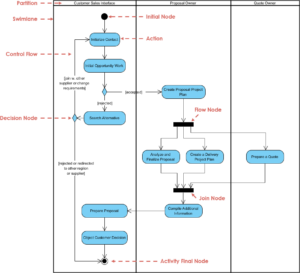
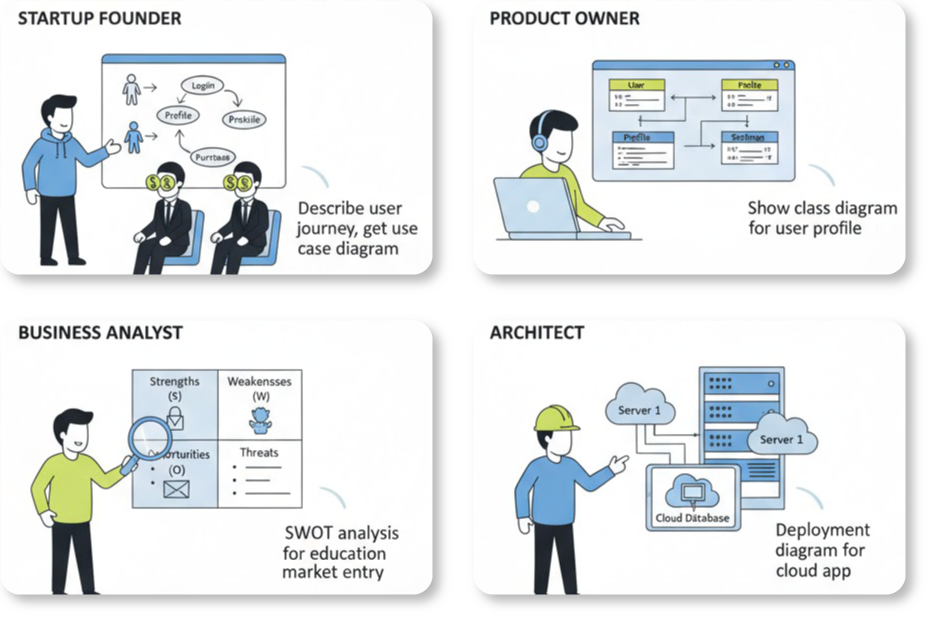
One of the platform’s standout features is the ability to describe ideas in plain text and receive professional-grade diagrams instantly. This capability supports a wide array of diagram types:
- Software Design: Instantly generate UML class diagrams, sequence diagrams, and activity diagrams.
- Business Process: Create detailed BPMN processes and CMMN models.
- Architecture: Generate ArchiMate views and C4 models for system context.
- Agile: Convert user stories directly into visual representations.
Purpose-Built AI Application Library
Visual Paradigm includes over 50 purpose-built AI apps designed to tackle specific business and technical challenges. These are not generic text generators but structured tools that produce analyzable outputs.

- Strategy Tools: Generate comprehensive SWOT, PESTLE, and Porter’s Five Forces analyses. Users can also create Business Model Canvases, Balanced Scorecards, and Blue Ocean Strategy maps.
- Agile Boosters: AI assists in backlog refinement, generating 3Cs for user stories, creating roadmaps, and synchronizing with Jira.
- Analysis Suites: Perform Root Cause Analysis, 5-Whys, Gap Analysis, and Lean Six Sigma DMAIC studies with AI guidance.
- Productivity: The platform even extends to content creation with article writers, infographic designers, and tools that convert text to Markdown presentations.
Industry-Standard Visual Modeling
While AI accelerates creation, the core strength of Visual Paradigm remains its deep support for industry standards. It provides a robust environment for rigorous modeling that goes far beyond simple drawing tools.
The platform supports an extensive list of standards, ensuring compatibility and compliance for enterprise architects and engineers:
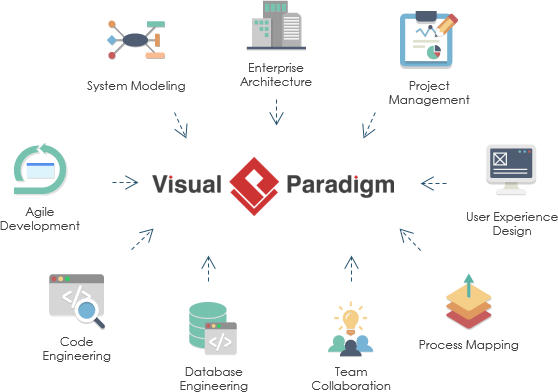
- UML 2.x and SysML: For object-oriented software design and systems engineering using SysML.
- BPMN, CMMN, and DFD: For precise business process modeling and data flow analysis.
- Enterprise Architecture: Full support for ArchiMate, TOGAF ADM, Zachman Framework, and DoDAF/NAF/MODAF viewpoints.
- General Diagramming: Includes flowcharts, ERD, organizational charts, mind maps, fishbone diagrams, and wireframes.
Bridging Design and Code
Visual Paradigm distinguishes itself from basic diagramming tools through its engineering capabilities. It serves as a bridge between high-level design and implementation code.
Round-Trip Engineering
Developers can generate code from diagrams and, conversely, reverse engineer existing code bases into visual models. This round-trip capability ensures that documentation stays synchronized with the actual software architecture.
Database and API Design
The platform streamlines backend development with tools for Entity Relationship Diagram (ERD) design, which can generate database schemas and Hibernate/ORM code. Additionally, the REST API designer allows for the visual creation of Swagger/OpenAPI specifications, facilitating better API governance.
Agile Management and Enterprise Transformation
For product owners and Scrum masters, Visual Paradigm offers a unified environment for managing projects alongside the models that describe them. The suite includes User Story Mapping, Scrum and Kanban boards, burndown charts, and retrospective tools. Stakeholder management is simplified with MoSCoW and Eisenhower matrices.
On the enterprise scale, the platform supports complex Enterprise Architecture transformation initiatives with migration roadmaps and dynamic Gantt visualizations, helping organizations navigate changes in technology and process effectively.
Collaboration and Team Productivity
Visual Paradigm is designed for teams. The platform creates a collaborative workspace featuring real-time concurrent editing, ensuring that distributed teams can work together seamlessly. Version control with history and revert capabilities provides a safety net for iterative changes.
Furthermore, the collaboration suite extends to PostMania for communication, task management features, and integration with major platforms like Confluence and Jira. A bonus productivity suite adds value with Markdown editors, PDF manipulation tools (convert, compress, protect), and flipbook publishing capabilities.
Conclusion
Whether you are a business analyst mapping a customer journey, a software architect designing a microservices environment, or a product owner refining a backlog, Visual Paradigm offers a consolidated, powerful environment. By combining rigorous support for standards like UML and TOGAF with cutting-edge Generative AI, it provides a scalable solution for modern enterprises. To experience these features firsthand, professionals can access the Free Trial to explore why this platform is the go-to choice for modeling and architecture worldwide.