
Payment processing is one of the most critical components of any digital commerce platform. When a user initiates a transaction, the backend system must coordinate across multiple services, external gateways, and internal ledgers with absolute precision. A single misstep can lead to double charges, lost funds, or a frustrated customer base. To manage this complexity, technical teams rely on sequence diagrams. These visual representations map the interaction order between objects, providing clarity on timing, state changes, and failure points.
This guide explores a specific case study focused on optimizing payment processing flows. We will examine how to leverage sequence diagrams to refactor backend code, reduce latency, and increase reliability. By analyzing the message flow between actors, developers can identify inefficiencies that are not immediately visible in the codebase.
Introduction to Transaction Visualization 📊
Understanding the lifecycle of a payment request requires more than just reading code. It demands a view of the system as a whole. Sequence diagrams serve this purpose by displaying the chronological order of interactions. In the context of backend optimization, these diagrams are not just documentation; they are diagnostic tools.
- Clarity: They reveal hidden dependencies between microservices.
- Timing: They highlight synchronous blocking calls that cause latency.
- Failure Points: They show where error handling is missing or insufficient.
When optimizing a payment flow, the goal is to maintain data integrity while maximizing throughput. This requires a shift from thinking about individual functions to thinking about the flow of control across the distributed system.
The Scenario: A High-Volume Checkout System 🛒
Consider a scenario where a backend system handles thousands of transactions per minute. The current architecture involves a Client Application, an API Gateway, an Order Service, a Payment Service, and an external Payment Gateway. The initial sequence diagram depicts a straightforward, linear process.
The flow begins when the client sends a payment request. The API Gateway validates the token and routes the request to the Order Service. This service checks inventory, creates a pending order, and then calls the Payment Service. The Payment Service communicates with the external gateway to charge the card. Finally, a confirmation is sent back up the chain.
While this works for low volume, it presents risks at scale. The diagram shows a long chain of synchronous calls. If the external gateway is slow, the entire stack waits. If the database locks up during the order creation, the payment attempt hangs. These are the exact issues we aim to resolve.
Analyzing the Baseline Sequence Diagram 🔍
To optimize, we must first understand the current state. The baseline diagram reveals several critical characteristics:
- Strict Synchronicity: The client waits for a response from every step before moving forward.
- Stateless Communication: Intermediate states are not persisted until the final confirmation.
- Linear Error Handling: Errors propagate up the chain without local recovery mechanisms.
Let us break down the specific messages exchanged in this baseline flow:
- POST /charge: Client sends card details and amount.
- Validate & Route: Gateway checks authentication.
- Lock Inventory: Order Service reserves items.
- Create Pending Order: Database writes a record with status pending.
- Execute Transaction: Payment Service calls external API.
- Update Status: Payment Service updates database to completed or failed.
- Notify Client: API Gateway returns HTTP 200 OK.
Every arrow in this diagram represents a network round-trip. In a distributed environment, network latency is non-zero. Multiplying this by the number of steps creates significant delay. Furthermore, the diagram shows no mechanism for handling a situation where the network fails between step 6 and 7.
Identifying Bottlenecks and Risks ⚠️
Optimization begins with risk identification. The baseline sequence exposes specific vulnerabilities that threaten system stability.
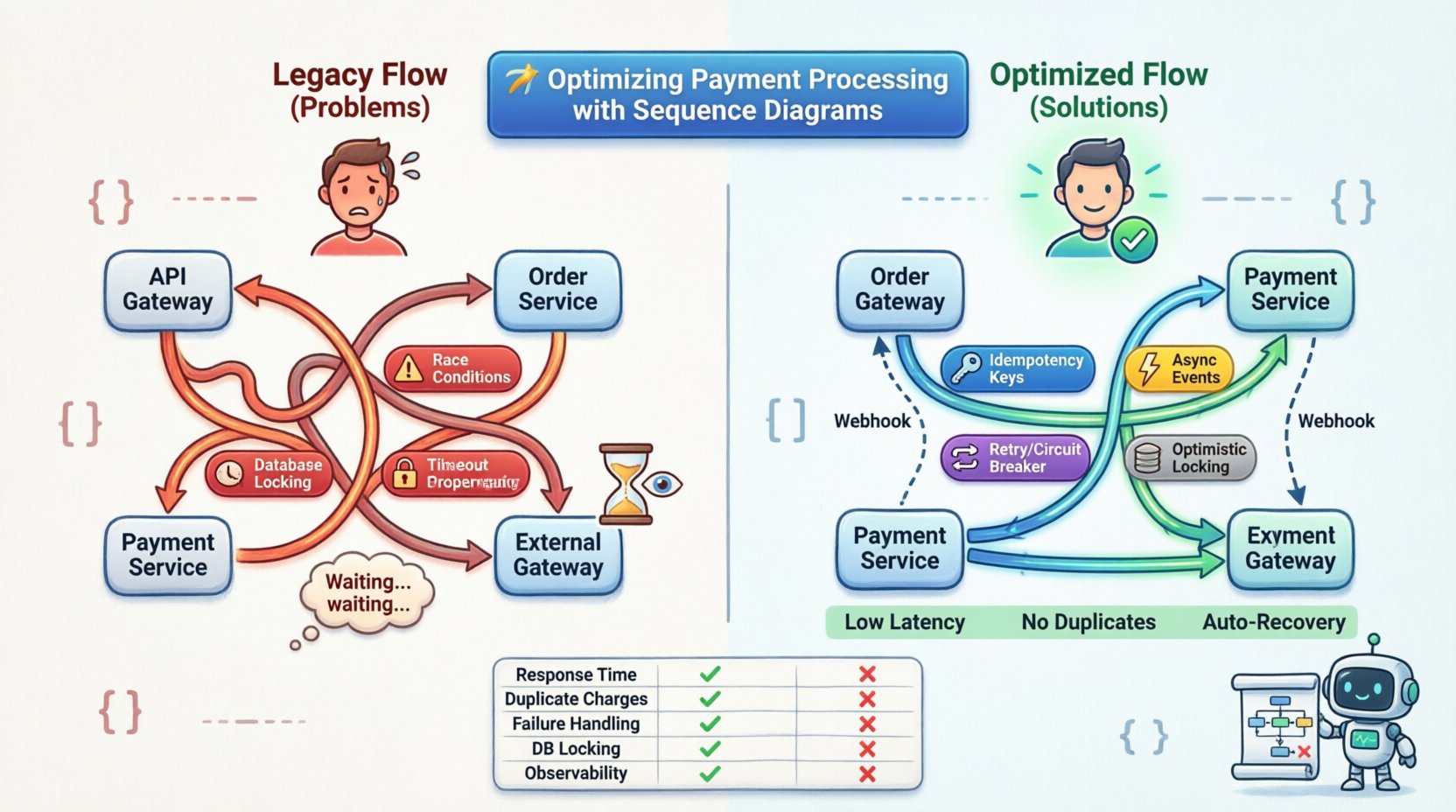
1. Race Conditions
If a user clicks the “Pay” button twice rapidly, the system might process two requests. The sequence diagram does not show any idempotency checks. Without a mechanism to recognize duplicate requests, the ledger will show two charges.
2. Timeout Propagation
External payment gateways often have their own timeouts. If the external call takes 5 seconds and the backend timeout is set to 3 seconds, the backend aborts the transaction. However, the external gateway might still succeed. This leads to a state where the user is charged, but the order remains pending.
3. Database Locking
The Order Service locks inventory before the payment is confirmed. If the payment fails, the inventory must be released. In the baseline diagram, this rollback logic is implied but not explicit. High contention on inventory rows can cause deadlocks.
4. Lack of Observability
The diagram shows no correlation IDs passing between services. When a failure occurs, tracing the specific request across the Order Service, Payment Service, and Gateway becomes difficult without a unique identifier attached to every message.
Strategy 1: Implementing Idempotency Keys 🔑
Idempotency ensures that performing an operation multiple times has the same effect as performing it once. In a payment context, this is non-negotiable. We must modify the sequence diagram to include a key exchange.
The client generates a unique ID for the transaction request. This ID travels with the payment payload. The backend checks its cache or database to see if this ID has already been processed. If it exists, the system returns the previous result instead of charging the card again.
Changes to the Sequence Diagram:
- Add a step where the Payment Service queries the cache for the idempotency key.
- Add a step where the service stores the key and result upon successful completion.
- Ensure the response includes the key to the client for future reference.
This change prevents duplicate charges even if the network retries the request. It adds a small latency overhead for the cache lookup, but it is a necessary trade-off for financial accuracy.
Strategy 2: Asynchronous Event Handling ⏱️
One of the biggest inefficiencies in the baseline flow is the synchronous waiting for the external gateway. We can refactor the diagram to use an asynchronous pattern for confirmation.
Instead of the Payment Service waiting for the gateway response before updating the order status, it should initiate the charge and then listen for a webhook. The initial response to the client confirms that the request was accepted, not that the money moved.
The New Flow:
- Client sends payment request with idempotency key.
- Order Service creates order with status processing.
- Payment Service initiates charge and returns immediately.
- Client receives accepted status.
- External Gateway sends webhook to Payment Service.
- Payment Service updates order to completed or failed.
- Notification Service alerts the user.
This decouples the client experience from the external provider’s speed. The user gets immediate feedback, while the backend handles the heavy lifting in the background.
Strategy 3: Robust Error Recovery Patterns 🔄
Errors are inevitable in distributed systems. The baseline diagram shows a simple failure path. The optimized diagram must include retry logic with exponential backoff and circuit breakers.
Retry Logic:
- If the external gateway times out, do not fail immediately.
- Queue the transaction for retry.
- Increase the wait time between retries to avoid overwhelming the provider.
Circuit Breakers:
- If the external gateway fails repeatedly, open the circuit.
- Stop sending requests for a set period.
- Allow the system to recover and alert the operations team.
These patterns must be reflected in the diagram. Add alternate fragments (alt) to the sequence diagram showing the retry path. This visualizes the resilience built into the code.
Strategy 4: Optimizing Database Interactions 🗄️
Database performance is often the hidden bottleneck in payment flows. The baseline diagram shows a write operation during inventory locking. We can optimize this by using optimistic locking instead of pessimistic locking.
Optimistic locking checks a version number or timestamp at commit time. If another transaction modified the row in the meantime, the commit fails, and the application retries. This reduces lock contention significantly.
Implementation Details:
- Include a version column in the order table.
- Update the version number during the status change.
- Catch the specific database exception for version conflicts.
- Re-fetch the order and retry the logic.
Additionally, ensure that the database transaction scope is as small as possible. Do not hold a database transaction open while waiting for an external network call. Separate the internal state update from the external network call.
Comparison: Legacy vs. Optimized Flow 📉
Visualizing the difference between the old and new approaches helps stakeholders understand the value of the refactor. The table below summarizes the key differences.
| Feature | Legacy Flow | Optimized Flow |
|---|---|---|
| Response Time | High (Blocking) | Low (Async) |
| Duplicate Charges | High Risk | Mitigated (Idempotency) |
| Failure Handling | Immediate Fail | Retry & Circuit Breaker |
| Database Locking | Pessimistic | Optimistic |
| Observability | Limited | Correlation IDs Included |
This comparison highlights that the optimized flow trades immediate certainty for system stability and accuracy. In payment processing, accuracy is more important than speed.
Verification and Testing Protocols 🧪
Once the sequence diagram is updated and the code is refactored, rigorous testing is required. Unit tests alone are insufficient for distributed flows. Integration tests must simulate the sequence of events.
- Contract Testing: Verify that the API Gateway and Payment Service agree on the message format.
- Chaos Engineering: Introduce network latency or service failures during tests to ensure the retry logic works.
- Idempotency Tests: Send the same request multiple times with the same key to confirm only one charge occurs.
- Load Testing: Simulate high volume to check if the database locking strategy holds under pressure.
It is crucial to verify that the new asynchronous flow does not leave orders in a processing state indefinitely. A scheduled job (cron) should scan for stuck orders and reconcile them with the external gateway.
Monitoring and Observability Integration 👁️
Optimization is not a one-time task. Continuous monitoring ensures that the sequence of events remains healthy. Every service in the flow should emit logs that include a unique correlation ID.
Key Metrics to Track:
- Success Rate: Percentage of successful transactions vs. total attempts.
- Latency: Time from request to final status update.
- Queue Depth: Number of transactions waiting for webhook confirmation.
- Error Rates: Frequency of specific error codes from the payment gateway.
When a spike in errors occurs, the correlation ID allows engineers to trace the exact path through the sequence diagram. This speeds up debugging significantly. Without this visibility, diagnosing a payment failure is like finding a needle in a haystack.
Common Pitfalls in Payment Diagrams 🚫
Even with a good plan, implementation errors can occur. Here are common mistakes to avoid when designing or updating payment sequence diagrams.
1. Ignoring Timeouts
Do not assume external services are always available. Every external call must have a defined timeout. If the diagram does not show a timeout, the code will likely hang.
2. Mixing Concerns
Do not mix business logic with infrastructure logic. The Payment Service should not know how to connect to the database. It should rely on a Repository layer. This keeps the sequence diagram focused on business interactions.
3. Over-Optimization
Do not add complexity where it is not needed. If a system handles 10 transactions a day, asynchronous processing might be overkill. Scale the architecture to match the load.
4. Lack of Cleanup
Always include a cleanup step in the diagram. If a transaction fails, resources (like inventory locks) must be released. If the diagram omits this, the system will eventually run out of inventory.
Final Thoughts on Reliability 🛡️
Optimizing payment processing flows is a continuous process of refinement. Sequence diagrams provide the blueprint for this work. By visualizing the interactions, developers can see where the system breaks and how to fix it.
The transition from a synchronous, linear flow to an asynchronous, resilient architecture requires discipline. It demands careful handling of state, robust error management, and clear communication between services. When done correctly, the backend becomes a stable engine that handles financial transactions with confidence.
Remember that the diagram is a living document. As the system evolves, the diagram must be updated. Regular reviews ensure that the code matches the design. This alignment prevents technical debt from accumulating in the payment layer.
Ultimately, the goal is not just to process payments, but to do so reliably. A well-structured sequence diagram is the foundation of that reliability. It turns complex code into a clear map, guiding the system through the chaos of distributed computing.
Next Steps for Implementation 🚀
To begin this optimization, follow these actionable steps:
- Audit Existing Flows: Document the current sequence diagrams for all payment endpoints.
- Identify Single Points of Failure: Look for synchronous calls that block the main thread.
- Design the New Diagram: Draft the optimized flow including idempotency and async steps.
- Prototype: Build a small service that implements the new pattern.
- Rollout: Deploy the changes behind a feature flag to control traffic.
- Monitor: Watch the metrics closely for the first 48 hours.
By following this structured approach, teams can modernize their payment infrastructure without introducing instability. The sequence diagram remains the central tool for navigating this complexity.