
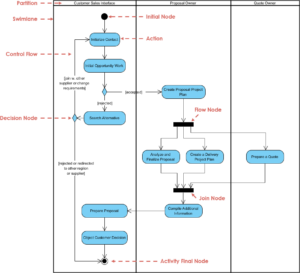
Data Flow Diagrams (DFDs) are essential tools in systems analysis and software engineering for modeling how data moves through a system. Unlike flowcharts, which focus on control logic and sequences, DFDs emphasize the flow and transformation of information. The rise of AI-powered tools has significantly simplified the creation and refinement of DFDs, enabling faster, more accurate modeling.
Understanding the Anatomy of a Data Flow Diagram
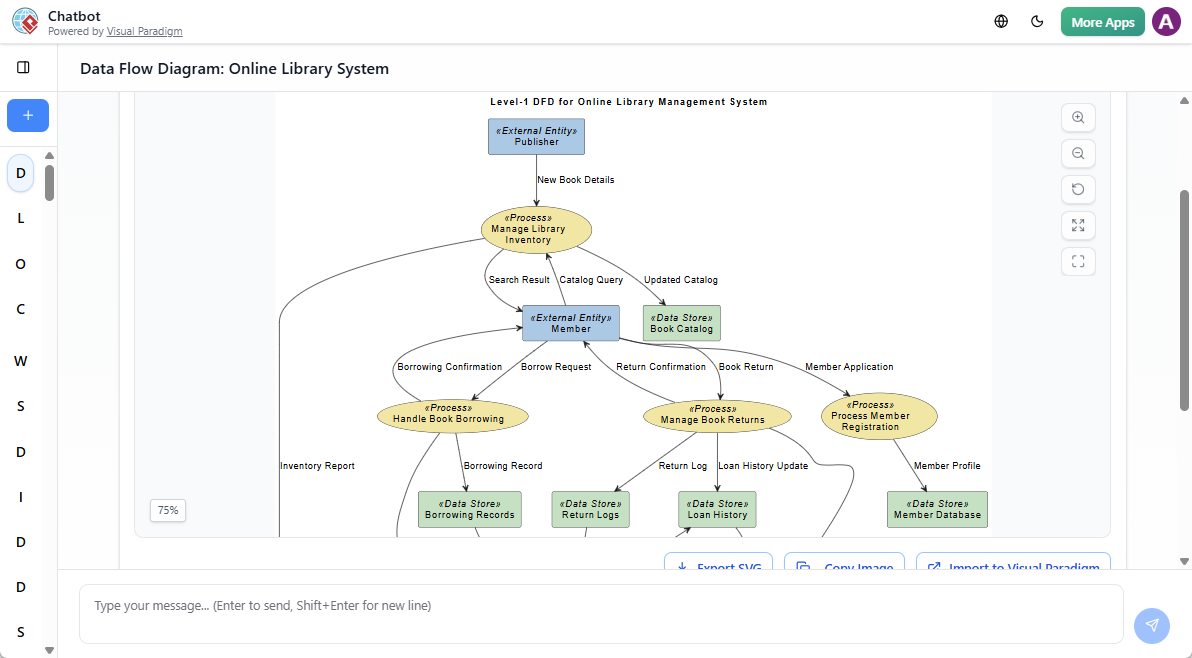
A DFD breaks down complex systems into manageable layers of abstraction using four core symbols:
- External Entities (squares or ovals): Represent outside agents such as users, departments, or external systems that interact with the system.
- Processes (circles or rounded rectangles): Show the operations that transform input data into output data.
- Data Stores (open-ended rectangles): Represent data at rest—such as databases, files, or spreadsheets—where information is stored.
- Data Flows (arrows): Indicate the movement of data between entities, processes, and data stores.
DFDs are structured in hierarchical levels:
- Level 0 (Context Diagram): Presents the entire system as a single process, showing its interactions with external entities.
- Level 1: Decomposes the system into major sub-processes.
- Level 2+: Further breaks down complex processes into detailed components.
This layered approach supports clarity and scalability in modeling.
How AI DFD Generators Enhance the Modeling Process
Traditional DFD creation involves manual drawing and careful notation. Modern AI DFD tools, like the Visual Paradigm AI Chatbot, streamline this process by enabling natural language input and automated diagram generation.
1. Generative Diagramming from Descriptions
Instead of manually placing shapes, users can describe a business process in plain language. For example:
“Create a Level 1 DFD for an e-commerce checkout process where the customer submits an order, the system checks inventory, processes payment via a gateway, and updates the shipping database.”
The AI interprets nouns as entities or data stores and verbs as processes, generating a structured DFD draft instantly.
2. Intelligent Refinement and Conversation-to-Action
The AI chatbot functions as a live collaborator, allowing users to refine diagrams through follow-up prompts (e.g “Add a data store for ‘Discount Codes’ and link it to the ‘Apply Discount’ process.”)
3. Export and Documentation
Once generated, the DFD can be exported to Visual Paradigm Online or Desktop. Or you can export the diagram as SVG image.
Why Use an AI DFD Tool?
An AI DFD generator reduces the time and cognitive load required to model complex systems. It enables rapid prototyping, real-time collaboration, and error-free diagrams—especially valuable in agile environments where requirements evolve quickly.
For teams focused on systems analysis, software design, or business process modeling, an AI-powered DFD tool enhances productivity and accuracy.
Conclusion
AI DFD tools like the Visual Paradigm AI Chatbot represent a shift from manual drawing to intelligent, conversational modeling. By interpreting natural language, automating structure, and validating logic, these tools make DFD creation faster and more accessible.
Whether you’re modeling a retail checkout system, a customer service workflow, or a supply chain process, an AI DFD generator helps you focus on the logic of data flow rather than the mechanics of diagramming.
Related posts:
 10 DFD Examples: Data Flow Diagrams Generated with Visual Paradigm AI Chatbot
 Visual Paradigm’s AI UML Generator: Streamlining Agile Workflows in Software Development
 How to Generate and Refine Use Case Diagrams with AI: A Practical Guide
 A Review of Modeling Relational Databases with ERD in Visual Paradigm