
Introduction: Stop Reading, Start Modeling
After my last deep-dive into ERD examples, I received dozens of messages asking: “What’s next?” The answer is simple: more practice with diverse, real-world patterns. Theory teaches you the rules; examples teach you when to bend them.
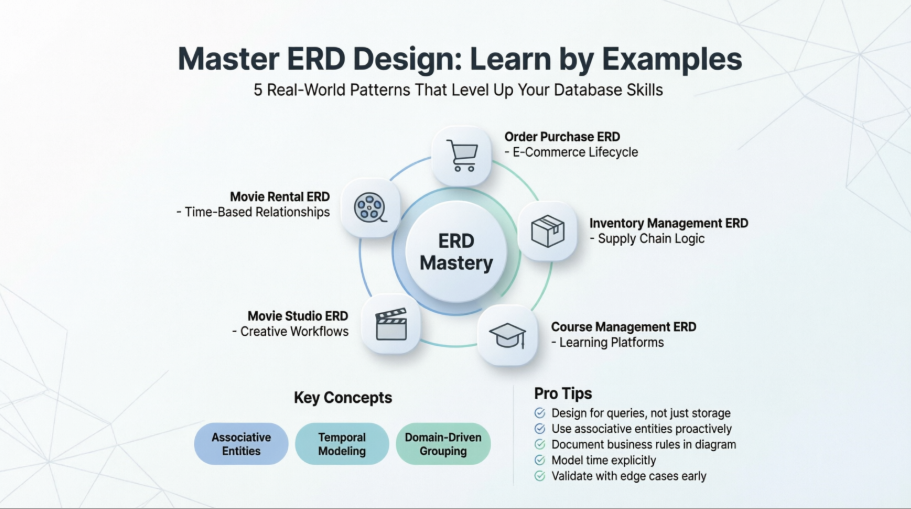
In this follow-up tutorial, I’ve selected five different ERD examples from Visual Paradigm’s library—each targeting a unique domain and teaching advanced concepts you won’t find in beginner guides. Whether you’re modeling e-commerce flows, supply chains, or creative production pipelines, these examples will expand your mental toolkit.
Let’s skip the fluff and learn by doing.
Quick Refresher: 3 Advanced Concepts We’ll Practice
Before we jump in, here are the higher-level patterns these examples reinforce:
🔹 Associative Entities: Junction tables that turn many-to-many relationships into first-class objects with their own attributes
🔹 Temporal Modeling: Capturing time-based state (rental periods, inventory snapshots, production phases)
🔹 Domain-Driven Grouping: Organizing entities by business capability rather than technical convenience
Ready? Let’s build.
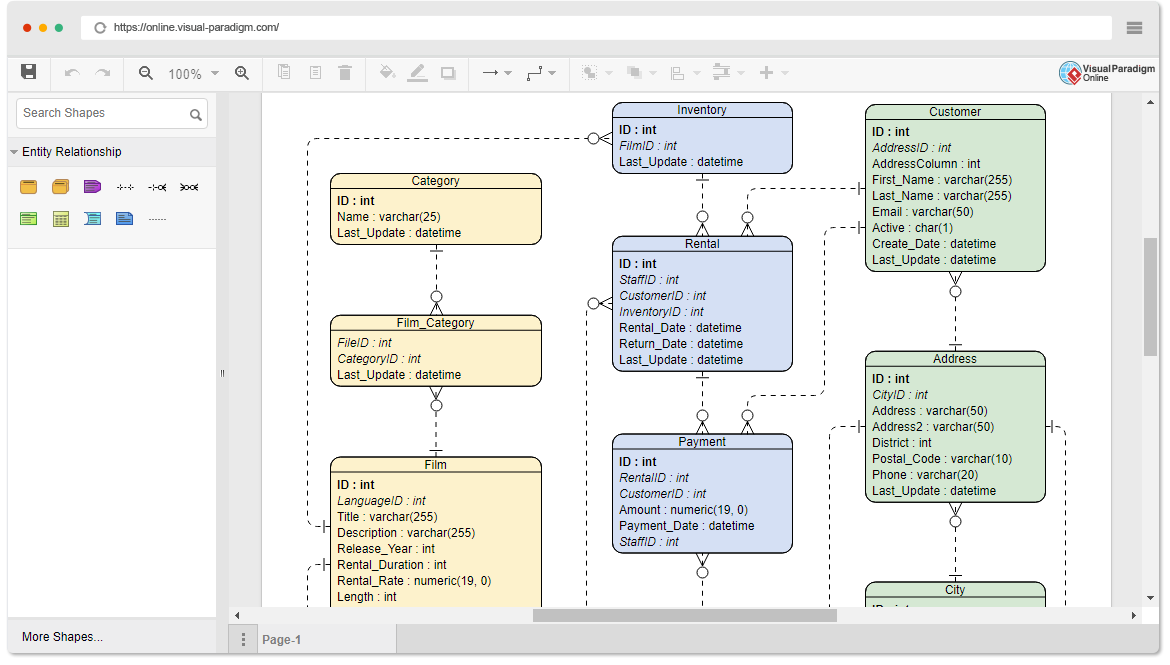
Example 1: Simple Movie Rental ERD (Mastering Time-Based Relationships)
What This Example Teaches
-
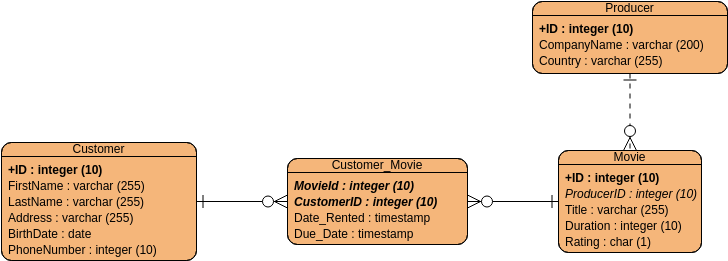
Modeling rental periods with
start_dateandend_dateattributes -
Handling inventory availability (
MovieCopyvs.Movietitle) -
Calculating derived values (late fees) from temporal relationships
My “Aha!” Moment
I used to model “Movie” as a single entity. This example taught me to separate catalog metadata (Movie: title, director, genre) from physical inventory (MovieCopy: copy_id, condition, location). This pattern is essential for any rental, lending, or reservation system.
Pro Tips for This Pattern
✅ Always distinguish between a product definition and its instances when tracking availability
✅ Store both rental_date and due_date explicitly—don’t calculate due dates on the fly
✅ Add a status attribute (available, rented, maintenance, lost) to inventory entities for quick filtering
Example 2: Order Purchase Entity Relationship Diagram (E-Commerce Order Lifecycle)
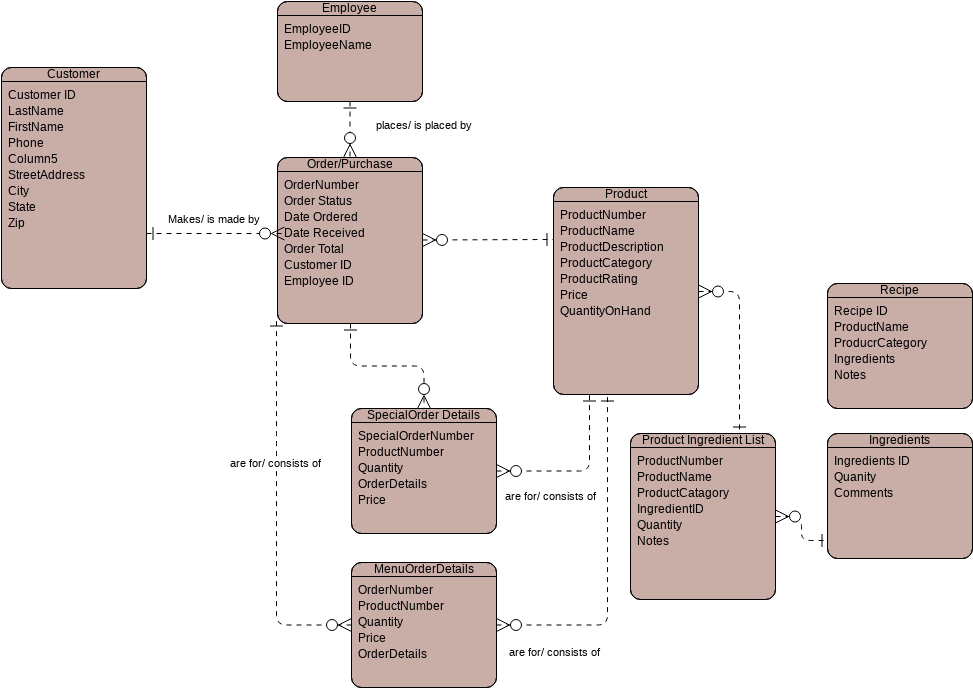
Order Purchase Entity Relationship Diagram
What This Example Teaches
-
Order state machines (
Orderwithstatus: pending, paid, shipped, delivered) -
Payment decomposition (
Payment,Refund,PaymentMethodas separate entities) -
Shipping and fulfillment tracking (
Shipment,TrackingEvent)
My “Aha!” Moment
This example showed me why order history is immutable. Instead of updating an Order record, each state change creates a new OrderStatusLog entry. This pattern enables audit trails, customer support debugging, and accurate reporting—critical for any transactional system.
Pro Tips for This Pattern
✅ Model payments as separate entities to support partial payments, splits, and refunds
✅ Include snapshot_price and snapshot_currency in OrderItem—never reference live product pricing
✅ Use a status_history or event_log pattern for any entity with a lifecycle
Example 3: ER Diagram: Inventory Management System (Supply Chain Logic)
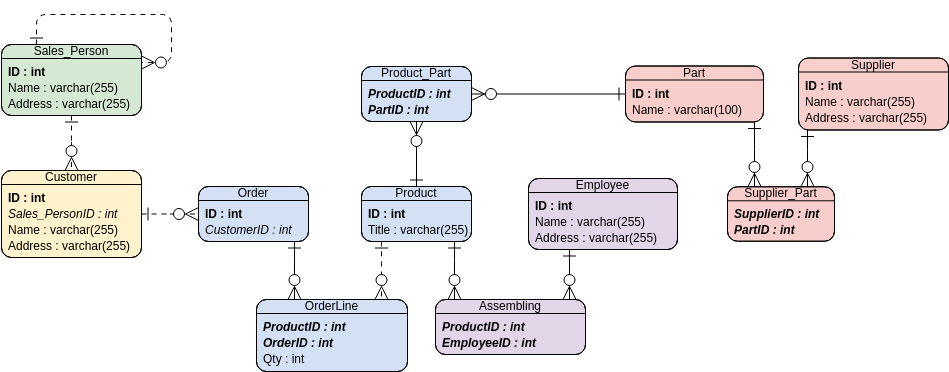
ER Diagram: Inventory Management System
What This Example Teaches
-
Multi-location inventory tracking (
Warehouse,StockLevelper location) -
Reorder logic (
ReorderRulewith min/max thresholds, lead time) -
Movement auditing (
StockTransactionfor every inbound/outbound event)
My “Aha!” Moment
I learned that inventory is a flow, not a state. Instead of just storing “current quantity,” this model logs every movement (StockTransaction) with type (receive, sell, adjust, transfer). This makes reconciliation, forecasting, and anomaly detection possible.
Pro Tips for This Pattern
✅ Every inventory change should create an auditable transaction record—never just UPDATE a quantity field
✅ Model StockLevel as a derived view or materialized table, not the source of truth
✅ Include batch_id or lot_number on transactions for recall tracking and expiry management
Example 4: ERD Example: Course Management System (Learning Platform Patterns)
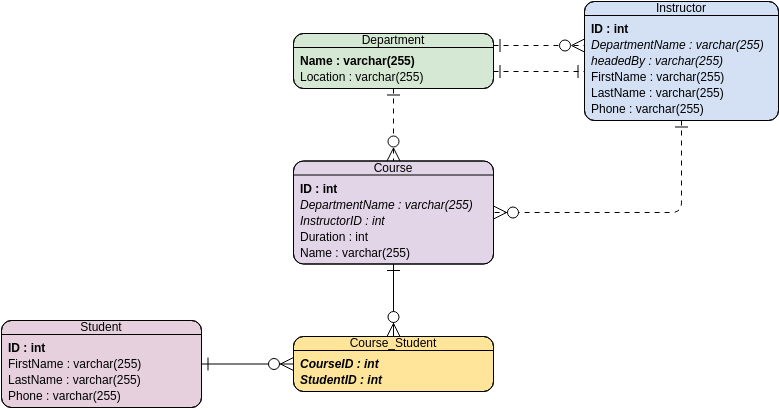
ERD Example: Course Management System
What This Example Teaches
-
Hierarchical content modeling (
Course→Module→Lesson→Quiz) -
Progress tracking (
Enrollmentwithcompletion_status,last_accessed) -
Assessment flexibility (
Assignment,Quiz,Projectas subtypes ofAssessment)
My “Aha!” Moment
This example introduced me to polymorphic relationships done right. Instead of separate tables for every assessment type, a base Assessment entity with a type discriminator lets you query all graded items uniformly while still supporting type-specific attributes.
Pro Tips for This Pattern
✅ Use a content_item base entity for reusable components (video, text, quiz) that appear in multiple courses
✅ Store progress_percent as a calculated field or cache it—don’t recalculate on every page load
✅ Model prerequisites as a self-referencing relationship on Course or Module with a required_score attribute
Example 5: Movie Studio Entity Relationship Diagram (Creative Production Workflows)
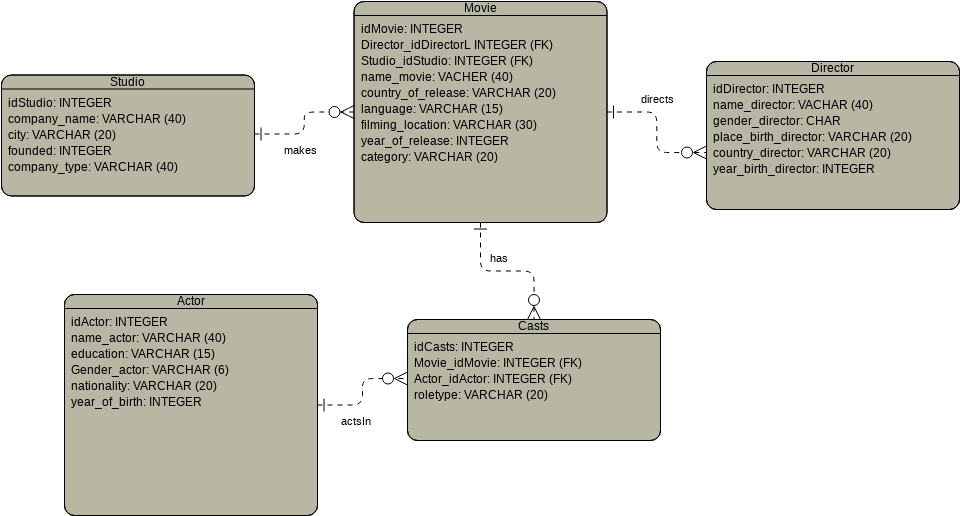
Movie Studio Entity Relationship Diagram
What This Example Teaches
-
Complex many-to-many with attributes (
CastMemberlinksActor+Production+Role+billing_order) -
Rights and distribution modeling (
License,Territory,Windowentities) -
Budget tracking with versioning (
Budget,BudgetRevision,ExpenseCategory)
My “Aha!” Moment
This example taught me how to model creative collaboration at scale. Instead of a flat Credit table, the CastMember and CrewMember associative entities capture nuanced relationships: an actor can play multiple roles, a director can work on multiple phases, and compensation varies by contract type.
Pro Tips for This Pattern
✅ Use associative entities with rich attributes whenever relationships carry business logic (compensation, credit order, approval status)
✅ Model rights and licenses as time-bound, territory-specific entities—never hardcode business rules in application logic
✅ Add version or revision tracking to financial entities to support audit and approval workflows
My 5 Advanced ERD Tactics (Learned From Real Projects)
After modeling dozens of systems, these strategies consistently save time and prevent rework:
-
Design for queries, not just storage
Ask: “What reports will stakeholders need?” Then ensure your relationships support those joins efficiently. -
Use associative entities proactively
If a relationship might need its own metadata (date, status, notes), make it an entity from day one. -
Document business rules in the diagram
Add floating note boxes for rules like “A movie can’t be released before post-production approval”—future maintainers will bless you. -
Model time explicitly
Addvalid_from/valid_tofor slowly changing dimensions (pricing, roles, permissions) to enable historical analysis. -
Validate with edge cases early
Test your model against scenarios like “What if a rental is returned late?” or “What if a course is archived mid-semester?” before coding begins.
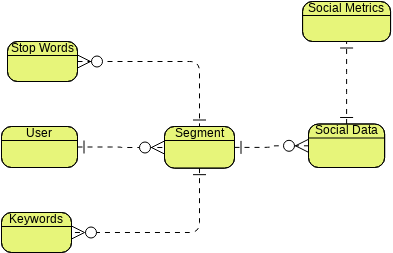
Conceptual ERD
Designed by @Gugu Dev
Conclusion: Build Confidence Through Deliberate Practice
Great database design isn’t about memorizing notation—it’s about recognizing patterns across domains. By studying these five diverse examples, you’ve seen how the same core concepts (entities, relationships, cardinality) adapt to rentals, e-commerce, supply chains, education, and creative production.
Your next step? Pick one example that mirrors a project you’re working on. Fork it in Visual Paradigm’s Online ERD Tool. Then break it intentionally: remove an entity, change a cardinality, add a new attribute. See what breaks. Fix it. That iterative experimentation is where expertise is forged.
The best part? Visual Paradigm’s template library has dozens more examples waiting. Treat each one as a mini-case study. Reverse-engineer the thinking. Adapt the patterns. Soon, you won’t just draw ERDs—you’ll design data architectures that scale, evolve, and deliver real business value.
Which example will you fork first?
Reference List
-
Visual Paradigm Online ERD Tool: Intuitive, browser-based platform for creating professional ER diagrams with drag-and-drop editing, real-time collaboration, and extensive template library.
-
Simple Movie Rental ERD: Practical example demonstrating inventory instance modeling, time-based rental relationships, and availability tracking for lending systems.
-
Order Purchase Entity Relationship Diagram: Comprehensive e-commerce order lifecycle model featuring state management, payment decomposition, and fulfillment tracking patterns.
-
ER Diagram: Inventory Management System: Supply chain reference showcasing multi-location stock tracking, reorder logic, and auditable inventory movement flows.
-
ERD Example: Course Management System: Learning platform example illustrating hierarchical content modeling, progress tracking, and polymorphic assessment patterns.
-
Movie Studio Entity Relationship Diagram: Advanced creative production model demonstrating complex many-to-many relationships with attributes, rights management, and budget versioning workflows.