
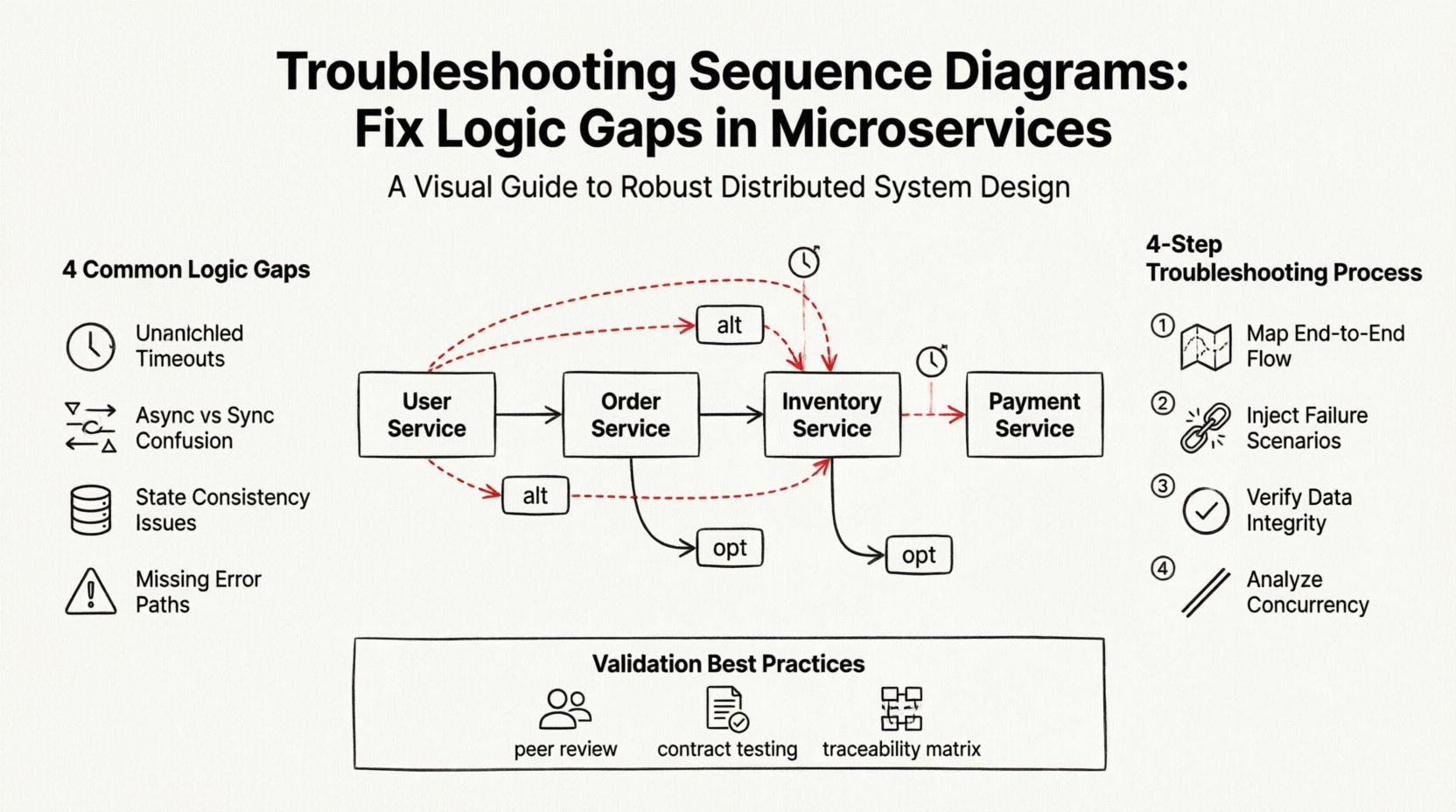
Distributed systems are complex. When multiple services interact to fulfill a single request, the communication flow can become opaque. Sequence diagrams serve as the blueprint for these interactions, mapping out how data moves between components over time. However, even the most detailed diagrams can harbor hidden flaws. Logic gaps in these visualizations often translate directly to production errors, latency spikes, and data inconsistencies.
This guide provides a structured approach to identifying and resolving logic gaps within microservices architecture. By focusing on validation, flow consistency, and error handling, you can ensure your system designs are robust before code is ever written.
🧩 Understanding Sequence Diagrams in Microservices
Before diving into troubleshooting, it is essential to understand what a sequence diagram represents in a distributed context. Unlike monolithic applications where components reside within the same memory space, microservices communicate over a network. This introduces variables that do not exist in single-process systems.
Key Elements of a Microservices Sequence Diagram:
- Participants: These are the distinct services (e.g., User Service, Order Service, Inventory Service) or external clients.
- Messages: Requests and responses exchanged between participants. These can be synchronous (blocking) or asynchronous (fire-and-forget).
- Activation Bars: Indicate when an object is actively performing an operation.
- Combined Fragments: Boxes denoting loops, alternatives, or optional interactions (e.g.,
alt,opt,loop). - Messages: The specific API calls or internal method invocations.
When logic gaps exist, the diagram fails to represent the actual runtime behavior. This discrepancy leads to the “expectation vs. reality” problem common in software development.
🚨 Common Logic Gaps in Distributed Flows
Logic gaps are not merely missing arrows; they are structural inconsistencies that break the reliability of the system. Below are the most frequent categories of issues found during diagram reviews.
1. Unhandled Timeouts and Latency
In a monolith, a function call returns instantly or throws an exception. In microservices, network latency is a constant factor. A common gap is failing to define what happens when a service does not respond within the expected window.
- Missing Timeout Arrows: Does the caller wait indefinitely? Is there a retry mechanism?
- Resource Leaks: If a downstream service hangs, does the upstream service hold open connections?
2. Asynchronous vs. Synchronous Confusion
Not all interactions require an immediate response. Mixing these patterns without clear distinction creates race conditions.
- Synchronous: The caller waits for a reply before proceeding.
- Asynchronous: The caller sends a message and continues without waiting.
If a diagram shows an asynchronous call but the logic assumes a return value, the application will crash or behave unpredictably.
3. State Consistency and Ordering
When multiple services update a shared state, the order of operations matters. Sequence diagrams must reflect the exact chronological order of updates to prevent race conditions.
- Ordering Errors: Updating inventory before confirming payment.
- State Divergence: Service A thinks an order is “Paid,” while Service B thinks it is “Pending” due to a message loss.
4. Error Propagation Paths
Happy paths are easy to diagram. The logic gaps usually appear in the error paths. A complete diagram must account for failures at every stage.
| Scenario | Common Gap | Impact |
|---|---|---|
| Service B Down | Caller assumes success | Partial data corruption |
| Network Partition | Missing retry logic | Lost transactions |
| Invalid Input | No validation step | Cascading failures |
| Rate Limiting | Overlooking quotas | Service degradation |
🔍 Step-by-Step Troubleshooting Guide
Fixing logic gaps requires a systematic review process. Follow these steps to validate and repair your sequence diagrams.
Step 1: Map the End-to-End Flow
Start by listing every service involved in a specific use case. Draw the primary flow from the initial client request to the final response. Do not worry about errors yet. Get the happy path down first.
- Identify Entry Points: Where does the request enter the system?
- Identify Exit Points: Where does the response leave?
- Check Service Boundaries: Ensure no single service is doing too much work (violating single responsibility).
Step 2: Inject Failure Scenarios
Now, break the flow. For every interaction, ask: “What if this fails?” Add alternative paths to the diagram.
- Network Failures: Add timeout and retry messages.
- Service Failures: Add error response messages returning to the caller.
- Data Failures: What if the database query returns null or an unexpected format?
Ensure that every success path has a corresponding error path. If a service sends a message, it must receive an acknowledgment or a rejection.
Step 3: Verify Data Integrity
Check the payload being passed between services. Does Service A send a User ID that Service B can actually use? Are data formats consistent (e.g., ISO 8601 dates vs. Unix timestamps)?
- Schema Validation: Ensure the message structure matches the contract.
- Field Propagation: Ensure all necessary fields travel from the source to the destination. A common gap is omitting a correlation ID needed for tracing.
Step 4: Analyze Concurrency and Parallelism
Microservices often fan out. A single request might trigger three parallel calls. Sequence diagrams can become cluttered here. Verify that the diagram correctly represents parallel execution.
- Wait Points: Does the main thread wait for all parallel tasks to complete?
- Race Conditions: Are there dependencies between parallel tasks that the diagram ignores?
- Timeouts: If one parallel task is slow, does it block the entire response?
🛡️ Validation Techniques and Best Practices
Once the diagram is drafted, validation is crucial. Use the following techniques to ensure the logic holds up under scrutiny.
Walkthroughs and Peer Reviews
Never review your own diagrams in isolation. Have a colleague trace the flow on the screen. Ask them to play the devil’s advocate. They might spot a missing error path that you overlooked.
- Role Play: Assign roles to participants (e.g., one person is the User Service, another is the Database).
- Trace Execution: Physically move a finger along the message arrows to simulate data flow.
- Challenge Assumptions: Ask “Why did we choose this pattern?”
Contract Testing Integration
While diagrams are design artifacts, they should align with contract tests. If the diagram specifies a specific response code, the contract test must verify that code exists.
- Verify Message Shapes: Ensure the API definition matches the diagram’s payload.
- Verify Status Codes: Check that 200, 400, 500, and 429 are all accounted for in the flow.
Traceability Matrix
Create a simple mapping between diagram elements and code artifacts. This ensures nothing is left behind during implementation.
| Diagram Element | Code Artifact | Status |
|---|---|---|
| Service A Request | Controller Endpoint | ✅ |
| Service B Processing | Business Logic Class | ⚠️ Pending |
| Timeout Logic | Retry Policy Config | ❌ Missing |
🧹 Maintenance and Documentation
A sequence diagram is a living document. It must evolve as the system changes. Outdated diagrams are worse than no diagrams at all, as they mislead developers.
Version Control for Diagrams
Store diagrams in your code repository alongside the source code. This ensures that when a feature is refactored, the diagram update is part of the same pull request.
- Commit Messages: Reference the diagram file in commit messages.
- Review Process: Include diagram updates in the code review checklist.
Automated Diagram Generation
Where possible, generate diagrams from code or configuration. This reduces the drift between design and implementation. While manual editing is often necessary for high-level architecture, low-level interactions can be inferred from API definitions.
Regular Audits
Schedule periodic reviews of critical flows. Every quarter, select a high-traffic use case and verify its sequence diagram against production logs.
- Compare Logs: Check if actual request times match the diagram’s assumptions.
- Check Error Rates: Did the error paths defined in the diagram actually trigger in production?
🧠 Advanced Scenarios: Handling Complex Interactions
Some scenarios require deeper analysis to resolve logic gaps effectively.
Event-Driven Architectures
In event-driven systems, services communicate via messages rather than direct requests. The sequence diagram changes from a strict timeline to a flow of events.
- Event Ordering: Ensure events are processed in the order they were emitted.
- Idempotency: Diagram must show how duplicate messages are handled without creating duplicate records.
- Dead Letter Queues: Include a path for messages that fail processing after all retries.
Distributed Transactions
When multiple services must commit or rollback together, the logic is complex. Two-phase commit (2PC) is rarely used due to performance issues; sagas are the modern standard.
- Compensating Actions: The diagram must show the rollback steps if a later step fails.
- State Machine: Visualize the state of the transaction at each step (e.g., PENDING, COMMITTED, COMPENSATING).
Security and Authentication Flows
Security gaps often hide in sequence diagrams. Ensure authentication tokens are passed correctly and securely.
- Token Propagation: Does the JWT or OAuth token travel from the API Gateway to the downstream services?
- Scope Validation: Is there a check for permissions at each service boundary?
- Encryption: Note where TLS is used between internal services (mTLS).
📈 Measuring Success
How do you know your troubleshooting efforts were successful? Look for these indicators in your development lifecycle.
- Reduced Onboarding Time: New developers understand the system faster with accurate diagrams.
- Fewer Production Incidents: Logic gaps resolved in design prevent runtime bugs.
- Faster Refactoring: Clear interaction maps make it safer to modify service boundaries.
- Better API Contracts: When diagrams are accurate, API definitions are more reliable.
🔗 Final Thoughts on System Design
Building reliable microservices is not just about writing code; it is about designing clear communication channels. Sequence diagrams are the map for this terrain. When you spot a logic gap, treat it as a critical bug in your architecture, not just a documentation error.
By rigorously applying the troubleshooting steps outlined above, you create a system that is easier to understand, debug, and scale. The effort invested in fixing these gaps early saves significant time during the maintenance phase. Remember that a diagram is a tool for thinking, not just for presentation. Use it to challenge your assumptions and validate your architecture against the reality of distributed computing.
Keep your diagrams updated, involve your team in the review process, and always prioritize error handling alongside happy paths. This disciplined approach leads to systems that perform consistently under pressure.