
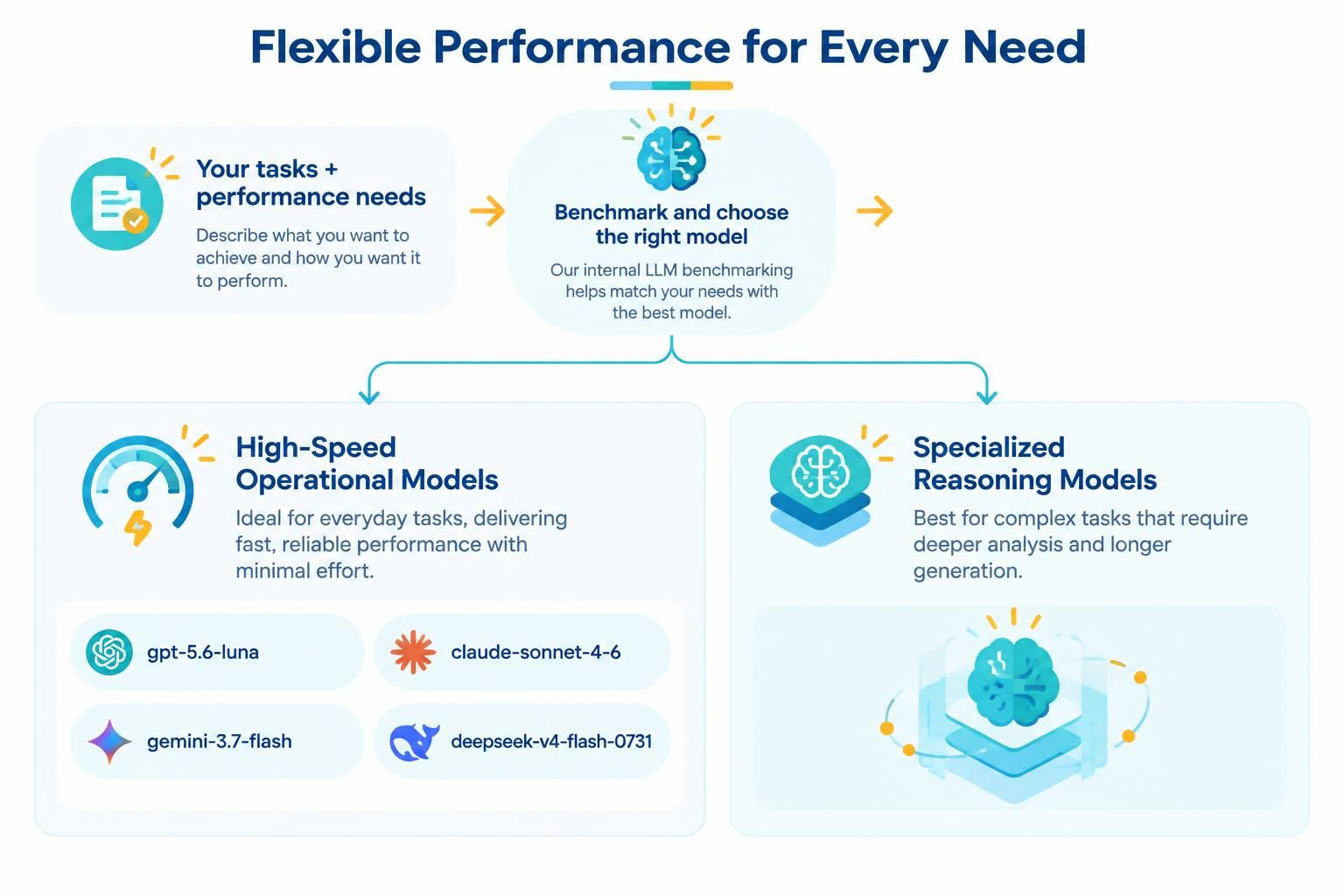
In the rapidly evolving landscape of Enterprise Artificial Intelligence, the challenge is rarely a lack of capability, but rather a surplus of options. The concept of “Flexible Performance for Every Need” represents a paradigm shift from monolithic, one-size-fits-all AI deployments to a dynamic, adaptive architecture. This tutorial explores the system logic depicted in the provided diagram, guiding you through the architectural decision-making process required to deploy a robust Self-Hosted AI Total Solution.
The Core Philosophy: Context-Aware Architecture
At the heart of this architecture lies a fundamental understanding: one size does not fit all. In a complex enterprise environment, a single model cannot efficiently handle the entire spectrum of workloads. A solution that excels at high-volume transaction processing may lack the nuance required for complex legal analysis, while a highly specialized reasoning model might be too computationally expensive for routine data entry.
The system architecture presented here is designed to act as an intelligent orchestrator. It does not simply route traffic; it analyzes the intersection of task requirements and performance constraints to direct requests to the optimal compute resource.
Step 1: Defining the Input Vector
The process initiates with a critical input phase, represented by the “Your tasks + performance needs” node. Before any model is queried, the system must perform a rigorous analysis of the incoming request. This is not just about the prompt text; it is about the metadata surrounding the task.
- Task Description: What is the specific business objective? Is it summarization, classification, or creative generation?
- Performance Constraints: What are the latency requirements (milliseconds vs. seconds)? What is the acceptable cost per token? Is data privacy (self-hosting) a hard constraint?
This initial filtering step is crucial. It transforms raw user intent into a structured set of technical requirements that can be matched against the available model capabilities.
Step 2: The Benchmarking Engine
Once the requirements are defined, the system engages the Internal LLM Benchmarking module. This is the “brain” of the flexible architecture. In a self-hosted environment, you cannot rely on public leaderboards alone, as external benchmarks often fail to capture the specific nuances of your proprietary data or your specific hardware configuration.
The benchmarking process involves:
- Workload Simulation: Running sample tasks through candidate models to measure real-world performance.
- Latency Profiling: Measuring time-to-first-token and total generation time under load.
- Accuracy Verification: Ensuring the output meets the quality standards defined in Step 1.
This engine acts as a gatekeeper, ensuring that only models that have passed the performance thresholds for a specific use case are selected.
Step 3: Strategic Model Routing
The output of the benchmarking process is a bifurcation of the architecture into two distinct operational lanes: High-Speed Operational Models and Specialized Reasoning Models. This separation of concerns is vital for maintaining system efficiency.
High-Speed Operational Models
The first lane is dedicated to efficiency. These models are engineered for throughput and speed, making them ideal for high-volume, everyday tasks where the cognitive load is low but the volume is high.
- Use Case: Routine data extraction, basic classification, customer service triage, and formatting tasks.
- Architecture Pattern: These models often utilize quantization and distillation techniques to maximize speed on consumer-grade or mid-range enterprise GPUs.
- Example Models: The architecture supports lightweight, fast variants such as
gpt-5.6-luna,claude-sonnet-4-6,gemini-3.7-flash, anddeepseek-v4-flash-0731. The “Flash” nomenclature in these examples typically indicates a focus on rapid inference.
Specialized Reasoning Models
The second lane is reserved for complexity. When the benchmarking engine detects a need for deep analysis, multi-step logic, or long-form content generation, it routes the request here.
- Use Case: Complex code generation, strategic planning, legal contract analysis, and scientific research synthesis.
- Architecture Pattern: These models prioritize context window size and logical coherence over raw inference speed. They are computationally intensive but necessary for tasks where “good enough” is not an acceptable outcome.
Implementation Strategy: The VPasCode Approach
When implementing this architecture using the Visual Paradigm AI Ecosystem (VPasCode), the goal is to create a Total Solution rather than a collection of isolated tools. This means the routing logic, the benchmarking engine, and the model repositories must be integrated into a cohesive self-hosted environment.
The diagram illustrates a flow that can be modeled as a state machine or a decision tree within your architectural documentation. By clearly defining the transition points between “Operational” and “Reasoning” states, you ensure that your enterprise infrastructure scales gracefully. You are not just deploying models; you are deploying a strategy that adapts to the complexity of your business needs.
Conclusion
The transition to a flexible, benchmark-driven AI ecosystem allows enterprises to optimize both cost and performance. By separating tasks into operational and reasoning categories, organizations can leverage the full power of their self-hosted infrastructure, ensuring that every token generated adds value to the business. This architectural approach is the cornerstone of a mature, scalable AI deployment.