
In the fast-paced world of software development, Agile projects often struggle with a specific paradox: the need for speed versus the necessity of clarity. Teams sprint to deliver value, yet without a clear understanding of “what the system does for its users,” functionality can drift into technical debt. This is where the marriage of traditional Use Case Modeling and modern Artificial Intelligence creates a transformative opportunity.
This tutorial explores how AI-assisted modeling shifts the paradigm from a burdensome documentation exercise to a strategic engine for Agile delivery. We will analyze why specific project natures are better suited for this approach and how the “Human-in-the-Loop” AI workflow solves the problem of agility in modeling.
The Agile Modeling Dilemma: Speed vs. Stability
Traditionally, Agile methodologies have sometimes viewed heavy modeling as an impediment to speed. However, pure “code-first” development can lead to fragmented systems where the architecture doesn’t match the user’s intent. Use Case Modeling, when done correctly, serves as the contract between stakeholders and development teams, ensuring that value is delivered rather than just features being built.
The challenge lies in the time cost. Generating a comprehensive model that covers all user goals, edge cases, and system interactions is a time-consuming endeavor. This is where AI changes the equation, transforming the modeling process from a “heavy” upfront activity into a rapid, iterative, and standards-compliant workflow.
Which Projects Benefit Most from AI-Driven Use Case Modeling?
Not every project requires the same level of architectural rigor. AI-powered modeling is particularly potent for projects with complex interactions or high stakeholder variability. Based on the principles of value-driven development, the following project types are best suited:
- Complex Business Logic Systems: Projects like banking, healthcare, or logistics where “flow of events” is critical. The AI can help identify missing conditional paths (e.g., “What happens if the user cancels mid-transaction?”) that human brainstorming might miss.
- Multi-Stakeholder Environments: Systems involving distinct roles (e.g., “Admin,” “Customer,” “Auditor”) benefit from the AI’s ability to instantly generate candidate actors and relationships, ensuring no role is left without a clear set of responsibilities.
- Legacy Modernization: When refactoring old systems, AI can help reverse-engineer the intended user goals from existing features, helping teams understand the “why” behind the code.
- High-Compliance Industries: Where traceability is mandatory (e.g., medical devices), the AI’s ability to enforce UML 2.5 standards and link use cases directly to test cases is invaluable.
The Agile Workflow: Is Use Case Modeling Possible?
The question often arises: Can we really do Use Case Modeling in an Agile environment? The answer is a resounding yes, but the approach must evolve.
In a traditional Waterfall setting, use case modeling was a massive upfront documentation phase. In an Agile context, it must be iterative. You do not model the entire system at once; you model the scope of the current sprint or epic. The goal is to create a “living” model that evolves with the user stories.
AI makes this iteration possible. Instead of spending days drawing diagrams, a team can generate a draft in minutes, refine it for the current sprint, and move to development. This aligns perfectly with Agile values: working software over comprehensive documentation, while ensuring that the documentation supports the software.
How AI Transforms the Agile Modeling Cycle
The integration of AI into the modeling workflow changes the role of the Business Analyst and Product Owner from “diagrammer” to “architect and validator.” Here is how the process works step-by-step:
1. Rapid Discovery (The “Draft”)
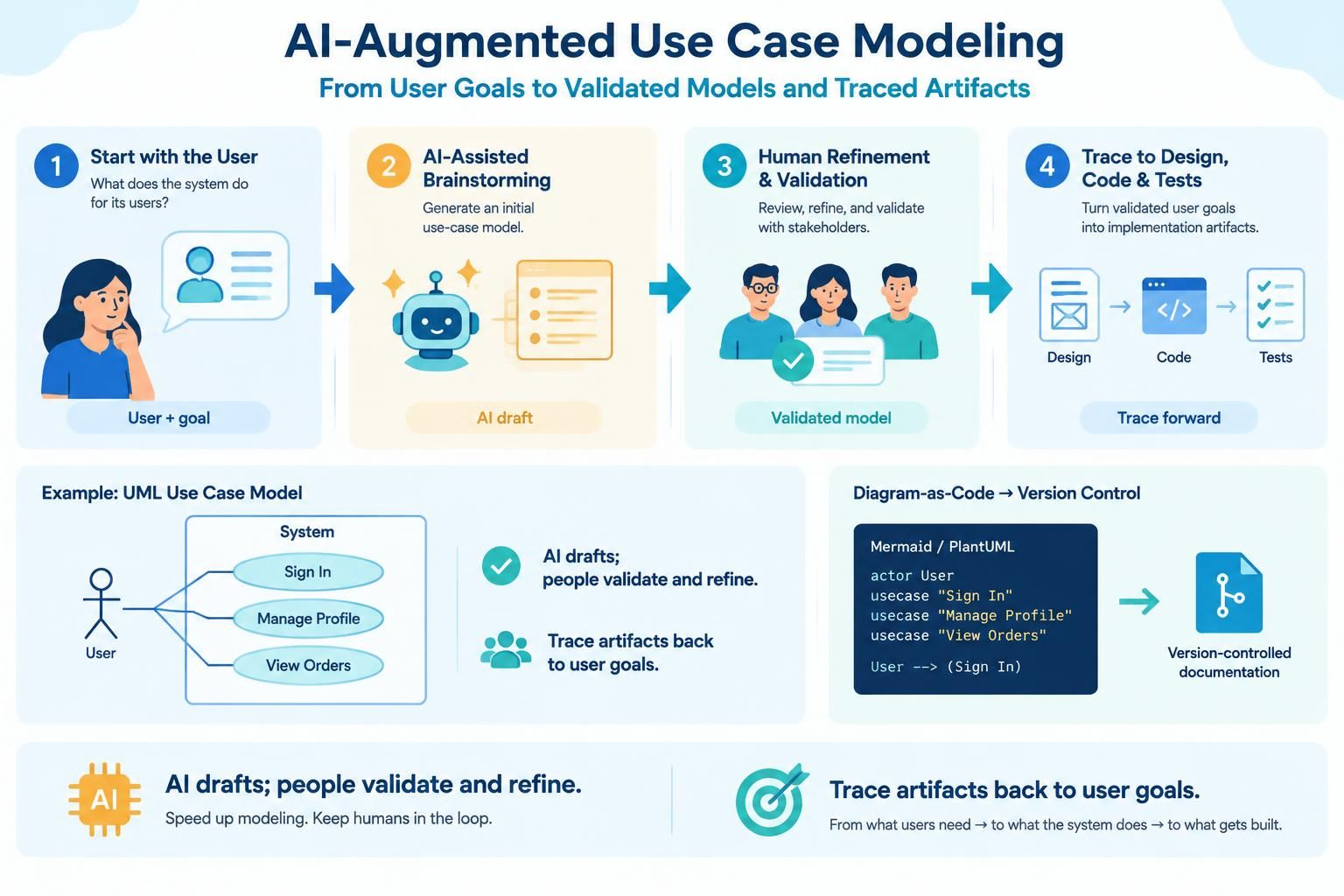
Instead of staring at a blank canvas, teams can describe the system scope in plain English. The AI engine analyzes this description to generate a complete initial model, including actors, system boundaries, and basic associations. This transforms the “brainstorming” phase from days to minutes, allowing the team to hit the ground running.
2. Intelligent Refinement (The “Review”)
Once the draft is generated, the AI acts as a quality assurance partner. It analyzes the model to suggest proper UML relationships. For example, it might identify that “Search Book” is a mandatory prerequisite for “Borrow Book” and suggest an «include° relationship, or that “Apply Discount” is an optional flow and suggest an «extend° relationship. This ensures the model adheres to industry standards without requiring deep UML expertise from every team member.
3. Flow of Events & Testability (The “Spec”)
A diagram alone is not enough for development. Agile teams need detailed specifications. AI tools can now generate “Flow of Events” documents directly from the use cases, outlining the main success scenario and alternative exception flows. This bridges the gap between the high-level diagram and the low-level test cases, ensuring that the “Definition of Done” is clear.
4. Diagram-as-Code (The “Version Control”)
For Agile teams utilizing Git and CI/CD pipelines, static image diagrams are often insufficient. AI tools can generate code representations (such as PlantUML or Mermaid) that can be version-controlled. This allows the diagram to be reviewed in pull requests alongside the code, ensuring that the model evolves in lockstep with the application.
Conclusion: The Future of Agile Requirements
AI-powered use case modeling does not replace the need for human insight; rather, it amplifies it. By automating the tedious aspects of diagramming and compliance checking, AI allows Agile teams to focus on what matters most: understanding user goals and delivering value. Whether you are a Business Analyst refining requirements or a QA engineer deriving test scenarios, this technology provides the speed and precision necessary to thrive in a modern, iterative development environment.