
E-Commerce Architecture Challenges That Visual Paradigm Solves
Modern e-commerce demands diagrams that capture:
- End-to-end customer journeys across touchpoints
- Microservices decomposition and API contracts
- Data consistency across services (inventory, pricing, orders)
- Security, scalability, and fault-tolerance patterns
- Integration points with external systems (Stripe, Shopify, Google Analytics, logistics APIs)
Visual Paradigm’s AI delivers accurate outputs: describe the scenario, get clean UML (class, sequence, component, deployment, activity) that follows standards and supports architectural patterns like CQRS, event sourcing, or hexagonal architecture.
Key E-Commerce Use Cases Powered by Visual Paradigm’s AI Chatbot
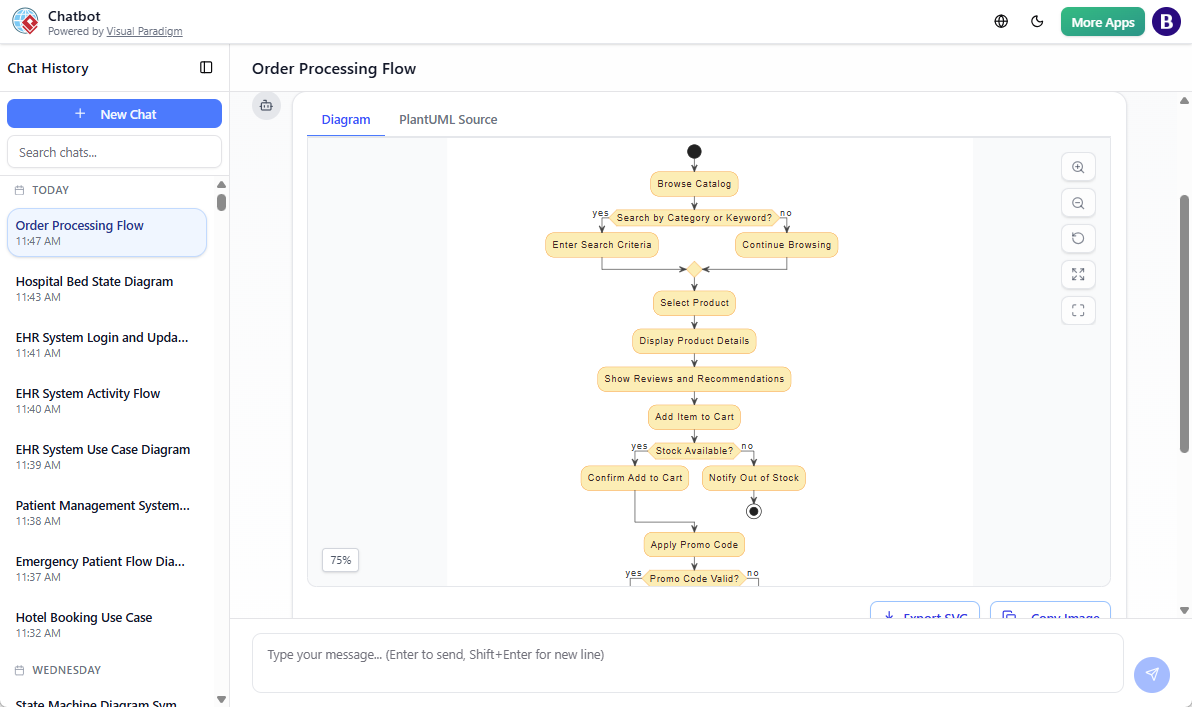
1. Customer Journey & Shopping Cart Flows (Activity & Sequence Diagrams)
Prompt example: “Generate an activity diagram for this scenario: Customer browses catalog, searches by category or keyword, views product details with reviews and recommendations, adds items to cart (with stock check), applies promo code, proceeds to checkout, selects shipping, pays via card or PayPal, receives order confirmation and tracking.”
Visual Paradigm generates an activity diagram with swimlanes (customer, storefront, cart service, payment gateway) and decision nodes, plus a sequence diagram showing temporal interactions and error paths (e.g., out-of-stock, payment failure).
2. Domain Modeling for Products, Orders & Inventory (Class Diagrams)
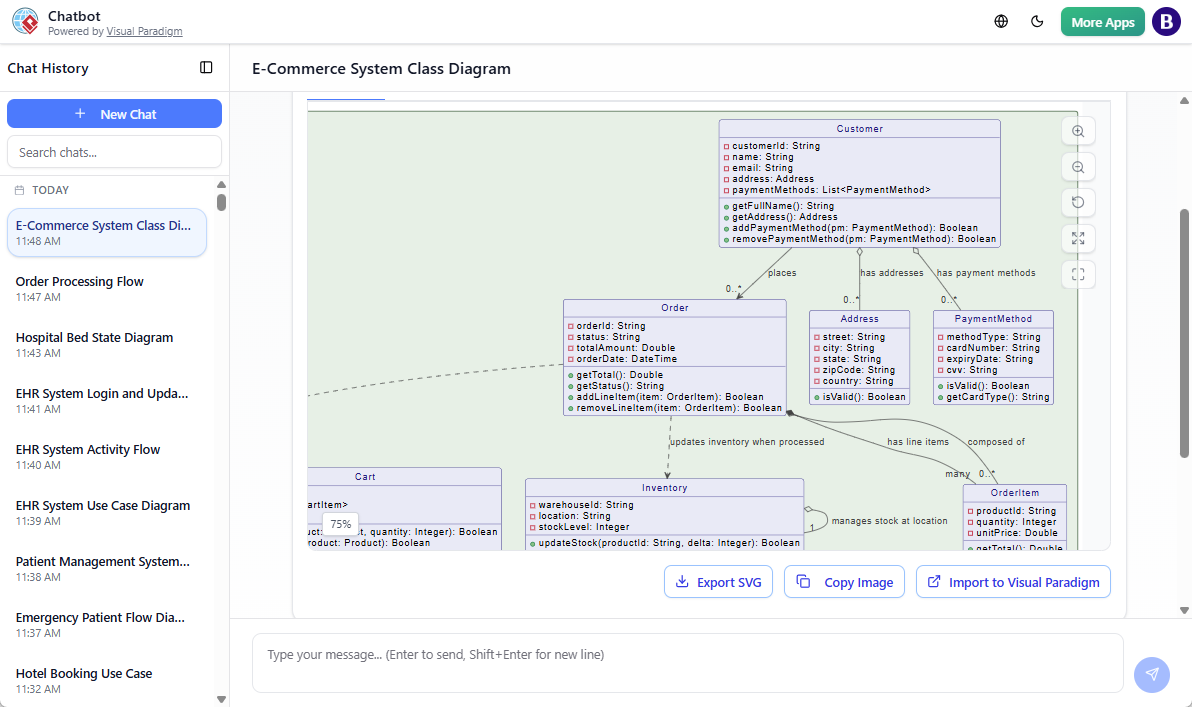
Input: “Generate a class diagram for an E-Commerce System: Core entities in an online store: Product (with variants, price, stock), Order (line items, status, total), Customer (profile, addresses, payment methods), Cart (temporary, persistent), Inventory (warehouse locations).”
The AI produces a detailed class diagram with associations, multiplicities, inheritance, and value objects—forming a solid domain-driven design foundation.
3. Microservices & API Interactions (Component & Sequence Diagrams)
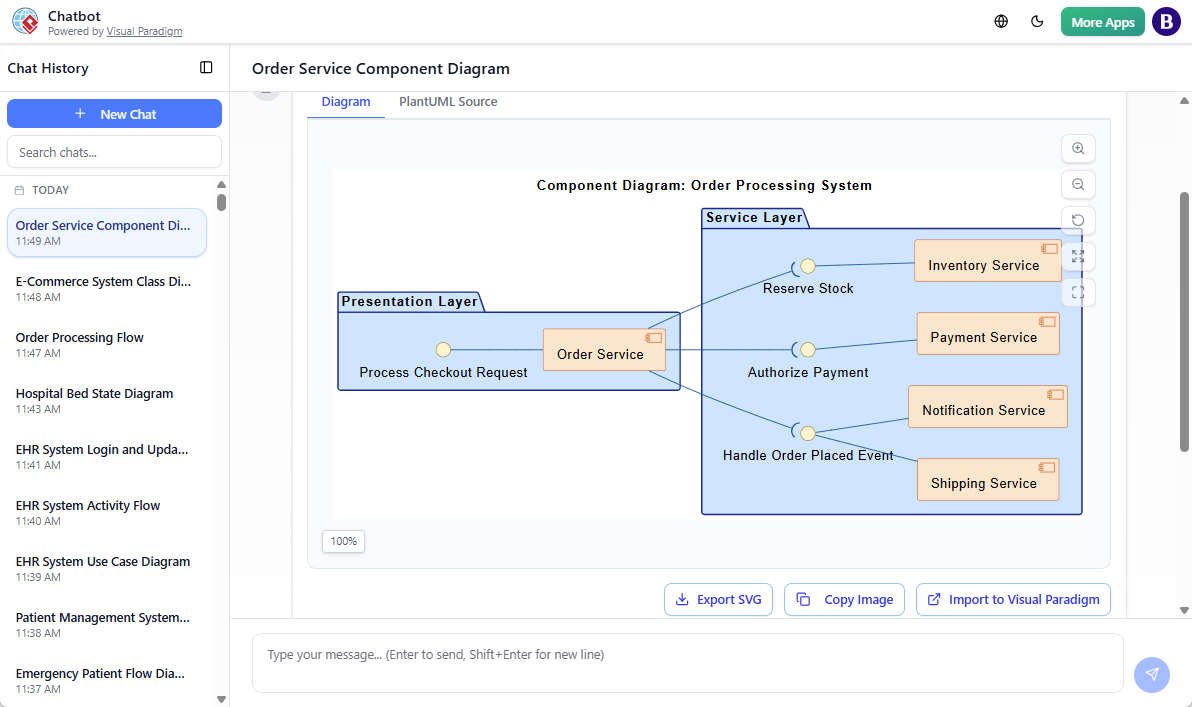
For distributed systems: “Create a Component Diagram: Order service receives checkout request, calls Inventory service to reserve stock, invokes Payment service for authorization, publishes OrderPlaced event to Shipping and Notification services.”
Visual Paradigm creates component diagrams showing service boundaries and dependencies among the layers.
4. Scalability & Deployment Architecture (Deployment Diagrams)
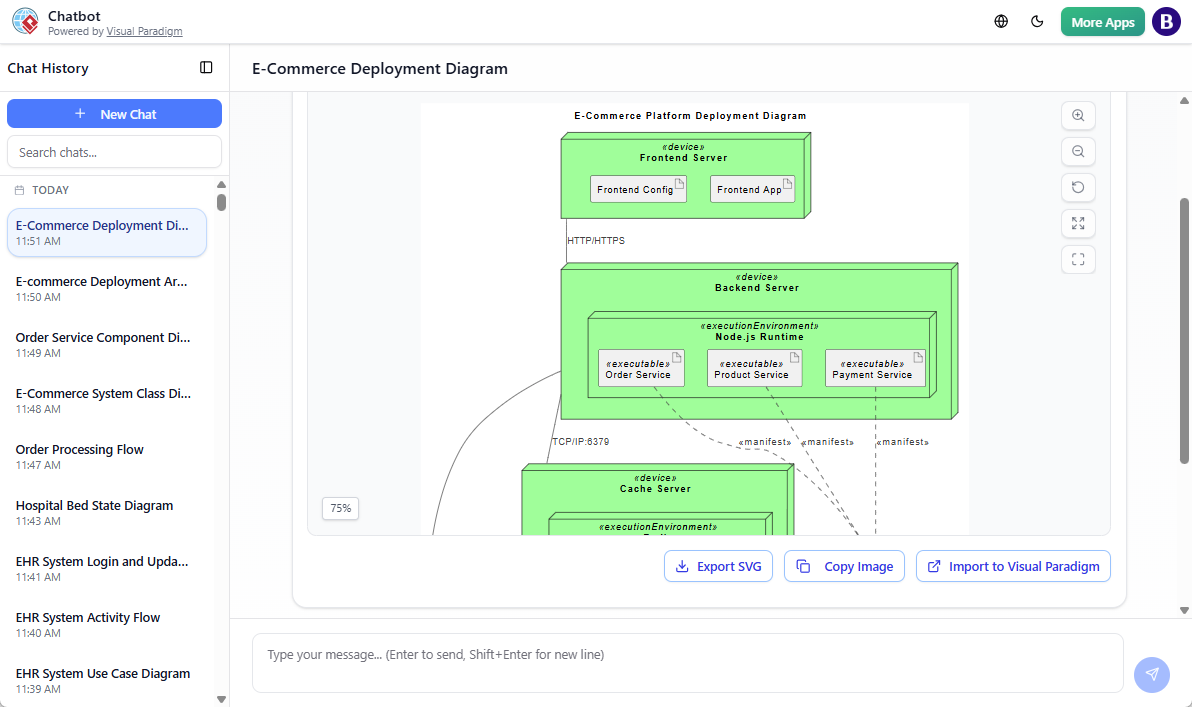
Prompt for deployment diagram: “Generate a Deployment Diagram for a E Commerce platform.”.
The AI outputs deployment diagrams visualizing nodes, artifacts, communication paths, and scaling considerations—helpful for capacity planning and cloud migration discussions.
Business & Technical Benefits for E-Commerce Teams
Teams using Visual Paradigm in e-commerce projects experience:
- 50–70% faster architecture documentation
- Clearer handoffs between product, design, and engineering
- Earlier detection of bottlenecks or single points of failure
- Better stakeholder buy-in with visual roadmaps
- Easier onboarding for new developers or agencies
Diagrams evolve with the platform—quickly updated during A/B tests, feature launches, or Black Friday scaling plans.
Why Visual Paradigm Leads in E-Commerce Architecture Design
Visual Paradigm’s AI UML generator is tailored for dynamic, high-scale environments with its versatile ecosystem:
- AI Visual Modeling Chatbot – Rapid ideation: describe a new checkout flow or promo engine in chat, iterate live during product meetings—perfect for fast-moving e-commerce squads.
- Web Apps – Browser-based guided modeling for quick domain sketches or journey maps—no setup, ideal for remote teams and quick prototypes.
- OpenDocs – Embed live diagrams in PRDs, tech specs, API docs, or investor decks—keeping visuals current as features ship.
- VP Desktop – Advanced capabilities for complex architectures: full UML/SysML, reverse engineering from code, traceability, and export to enterprise formats—essential for large-scale platforms.
Start casually in chat (brainstorming a flash sale feature), refine in desktop (microservices boundaries), embed in OpenDocs (share with partners)—all connected seamlessly. This makes Visual Paradigm the most complete AI UML generator for e-commerce’s pace and complexity. Explore the full ecosystem: Visual Paradigm AI Diagram Generator Ecosystem.
Practical Tips for E-Commerce Architects Using Visual Paradigm
- Include business constraints in prompts (e.g., “support 10k concurrent users”, “PCI-DSS compliant payment”)
- Generate layered views: high-level component for execs, detailed sequence for devs
- Use event-driven prompts for modern architectures (“publish OrderConfirmed event”)
- Combine diagrams with C4 model exports if needed for broader context
- Version diagrams with feature flags or release cycles
Design Your Next E-Commerce Milestone Faster
Visual Paradigm’s AI UML generator removes the diagramming bottleneck so e-commerce teams can focus on innovation, conversion, and scale. Describe your architecture vision—get professional visuals instantly.
Try it today: pick a core flow (cart abandonment recovery, multi-warehouse fulfillment, personalized recommendations), input it to Visual Paradigm’s chatbot, and see the clarity it brings to your design discussions.
Related Articles
Listed below are all the articles under the topic “AI UML Diagram Generator: Industry-Specific Applications”