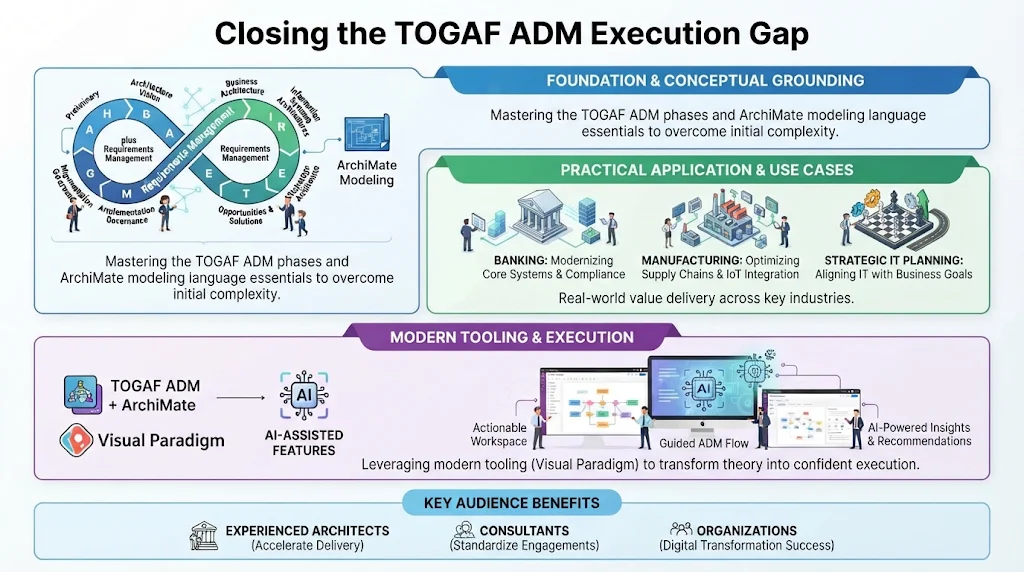
Enterprise Architecture (EA) often suffers from a paradox: the frameworks designed to bring clarity are themselves notoriously difficult to adopt. While TOGAF (The Open Group Architecture Framework) is the industry standard, many organizations struggle to bridge the gap between theoretical knowledge and practical execution. This tutorial explores how modern tooling, specifically the Visual Paradigm TOGAF ADM Guide-Through, combined with ArchiMate modeling and AI-assisted features, transforms the Architecture Development Method (ADM) from a bureaucratic hurdle into a streamlined, navigable workspace.
1. The Foundation: Understanding the TOGAF ADM Cycle
The core of TOGAF is the Architecture Development Method (ADM), an iterative, cyclic process for developing and managing the lifecycle of an enterprise architecture. To close the execution gap, one must first understand the structure of the ADM cycle.
The ADM consists of specific phases that guide architects from defining the scope to maintaining the architecture after implementation:
- Preliminary Phase: Defines the architecture capability and tailors the framework to the organization’s needs.
- Phase A (Architecture Vision): Establishes the scope, identifies stakeholders, and defines the high-level vision.
- Phases B, C, and D: These cover the development of the Baseline and Target Architectures for the Business, Information Systems (Application and Data), and Technology domains.
- Phase E (Opportunities and Solutions): Identifies work packages and delivery vehicles to move from the target architecture to implementation.
- Phase F (Migration Planning): Creates a detailed implementation and migration plan.
- Phase G (Implementation Governance): Ensures conformance during the implementation phase.
- Phase H (Architecture Change Management): Manages changes to the architecture to ensure it remains relevant.
- Requirements Management: A central, continuous process that handles requirements across all phases.
2. The Language: ArchiMate and ADM Integration
While TOGAF tells you what to do, ArchiMate provides the language to describe how it is done. ArchiMate is an open standard modeling language that maps cleanly to the ADM phases, ensuring that diagrams are consistent and standards-compliant.
In the context of the ADM Guide-Through, the mapping is often pre-configured to reduce cognitive load:
- Business Layer: Supports Phase B (Business Architecture).
- Application Layer: Supports Phase C (Application Architecture).
- Implementation & Migration Layer: Supports Phases E and F (Opportunities & Solutions, Migration Planning).
3. Practical Application: From Theory to Industry Use
The value of the TOGAF ADM lies in its adaptability across industries. Below are three representative scenarios where the ADM cycle was applied to deliver real-world value.
Banking Sector Transformation
In a case study involving Bank XYZ, TOGAF ADM was used to design a Learning Management System (LMS). By applying phases from Preliminary through Opportunities and Solutions, architects produced a blueprint and roadmap that aligned employee training processes with IT capabilities, ensuring security and performance through a centralized application server and VPN.
Industrial Manufacturing Optimization
For heavy industry, the Open Group published a case study on “Company A,” which used TOGAF ADM to optimize its Order-to-Delivery (OTD) value chain. This illustrates how ADM can be applied to end-to-end business processes rather than just IT systems, driving digital transformation in complex supply chains.
Strategic IT Planning for SMEs
Research on a heavy equipment rental company (PT. XYZ) demonstrated that ADM is not just for large enterprises. The framework provided a structured method to identify business needs, define an architectural vision, and create a roadmap, proving its utility for organizations needing to align IT with business goals on a smaller scale.
4. Modern Tooling: The Visual Paradigm Advantage
Visual Paradigm acts as the engine that transforms the abstract ADM cycle into a Visual Process Map. This navigable flowchart allows users to treat each phase and activity as a clickable node.
How the Guide-Through Works
When you open a TOGAF ADM project, you see the ADM cycle. The tool simplifies the workflow:
- Phase Interaction: Double-clicking a phase (e.g., Preliminary) reveals the specific activities and deliverables required.
- Activity Workspace: Double-clicking an activity opens a workspace with instructions, sample diagrams, and action buttons to create the necessary artifacts.
- Progress Tracking: Completed activities are marked with a checkmark, providing clear progress tracking.
Incremental Artifact Development
A standout feature is the reusability of artifacts. A business process diagram created in Phase B automatically becomes available as a building block for gap analysis in Phase E. You do not redraw; you enrich. At the end of a phase, deliverables (like the Architecture Definition Document) can be generated with a single click.
5. The Game Changer: AI-Assisted Features
The integration of generative AI into the TOGAF Guide-Through (introduced in Visual Paradigm 18.0) addresses the steep learning curve and manual effort traditionally associated with ADM.
Why AI Assistance?
The primary bottleneck in ADM is often the creation of artifacts—drawing diagrams, drafting gap analyses, and building roadmaps. AI reduces this manual drafting time, allowing architects to focus on strategic decision-making. It also lowers the barrier for organizations that lack deep TOGAF expertise, as the tool provides intelligent suggestions based on natural language descriptions.
Standout Capabilities
- Natural Language to ArchiMate: You can describe a scenario (e.g., “A retail digital transformation with omnichannel fulfillment”) and the AI generates a starter ArchiMate diagram illustrating the goal, capability, and realization relationships.
- Intelligent Gap Analysis: The AI can visualize the differences between baseline and target states by comparing models and highlighting missing or changed elements in editable views.
- Automated Roadmaps and WBS: For Phase E and F, the AI assists in generating work breakdown structures, transition timelines, and migration roadmaps, which can then be refined manually.
- Smart Radar Charts: For maturity or capability assessments, the AI helps populate radar charts that visualize strengths and gaps at a glance.
6. Tips and Tricks for Effective Use
To get the most out of the Visual Paradigm TOGAF ADM Guide-Through, consider the following best practices:
- Start with a Clear Narrative: The AI works best when you provide a concise, specific problem description. Instead of “improve business,” try “integrate the CRM with the billing system to reduce order-to-cash cycle time by 20%.” This yields more relevant ArchiMate diagrams.
- Treat AI Output as a Draft: Always review and refine AI-generated artifacts. The AI provides a structural scaffold; the architect provides the contextual nuance and organizational reality.
- Leverage the Guide-Through for Onboarding: New team members can use the built-in instructions and samples in the Visual Process Map to learn TOGAF on the job.
- Use the Repository as a Single Source of Truth: Visual Paradigm archives deliverables in a built-in architecture repository. Resist the urge to export and edit in external tools; keeping everything in the repository ensures traceability from requirements to implementation.
- Customize the Process Map: If your organization has a tailored ADM (e.g., integrating ITIL or agile sprints), Visual Paradigm allows you to configure the process map to reflect your specific governance gates and deliverables.
Conclusion
The TOGAF ADM is not a bureaucratic hurdle to be endured—it is a disciplined path to aligning business ambition with technological reality. Its value, however, has always depended on how well it is applied. When the framework is paired with a capable modeling language like ArchiMate and a tool that guides, rather than obstructs, the architect’s work, the ADM cycle becomes what it was always meant to be: a repeatable, transparent, and governable method for delivering change.
Visual Paradigm’s integration of the ADM guide-through, certified ArchiMate modeling, and AI-assisted artifact generation represents a meaningful shift in how enterprise architecture is practiced. It reduces the manual burden of diagramming and documentation, lowers the barrier to entry for teams new to TOGAF, and gives experienced architects more time for the strategic thinking and stakeholder engagement that no tool can replace.